
Technical guide for the VIESMANN VITOLIGNO 200-S high performance wood gasification boilers, covering principles of combustion, specifications, control…
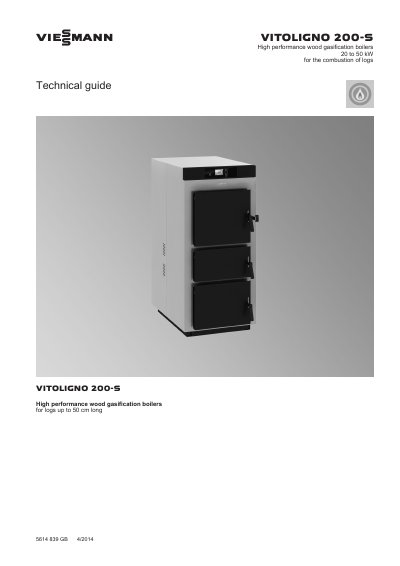
This document serves as a technical guide for the VIESMANN VITOLIGNO 200-S high performance wood gasification boilers, designed for the combustion of logs up to 50 cm long with an output range of 20 to 50 kW. It details the principles of wood combustion, including the influence of moisture and calorific values, and describes the product's features such as the large hopper, variable speed flue gas fan, and Ecotronic control unit.
The guide provides comprehensive specifications for the boiler and associated components, including DHW cylinders and heating water buffer cylinders. It also covers installation accessories, design information regarding positioning and clearances, hydraulic connections, and intended use, ensuring proper setup and operation of the system.
| Combustion efficiency | up to 92 percent |
|---|---|
| Combustion time | up to twelve hours |
| Heat-up time | three minutes |
The rated boiler heating output is achieved with dry wood with a maximum of 20 % water content or maximum humidity of 25 %.
Yes, with outputs of 30, 40 and 50 kW, it operates in modulating mode and adapts continuously to the current heat demand.