
This guide describes how to use the Viavi MTS 5800 to measure metro Ethernet performance using the enhanced RFC 2544 test method for Layer 3 IPv4.
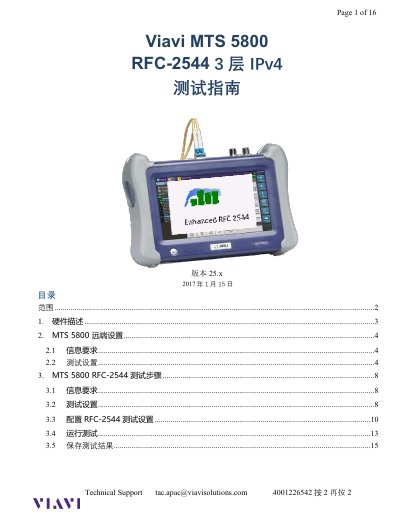
This document details the procedure for using the Viavi MTS 5800 to measure metro Ethernet performance based on the enhanced RFC 2544 test method. It covers setting up the device as a Layer 3 IPv4 loopback device and running tests to verify Key Performance Indicators (KPIs) such as throughput, latency, and frame loss, as well as jitter and Committed Burst Size (CBS). This manual is written in Chinese.
Viavi test sets (SmartClass, HST-3000, or MTS), Viavi test heads (QT-600), Viavi-compatible NID, or Viavi JMEP compatible SFP.
MTS 5800 -100G requires software release 25.0 or later; MTS 5800v2 requires software release 25.1 or later.
CAT 5E or better cable for connecting the RJ-45 port to the test port.