
This application note defines Composite Second Order (CSO) and Composite Triple Beat (CTB) and explains two measurement methods for the Trilithic 860 DSPi.
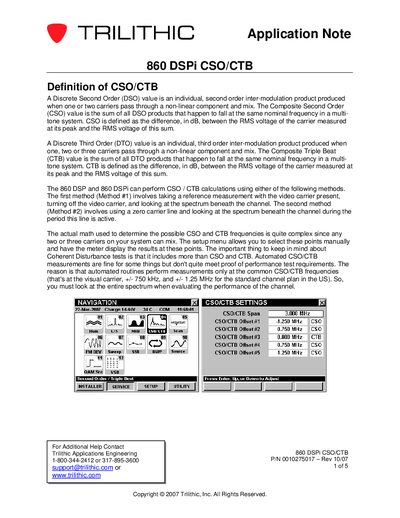
This document defines Composite Second Order (CSO) and Composite Triple Beat (CTB) values as the sum of inter-modulation products at a specific nominal frequency. It details the mathematical definitions involving RMS voltage differences and explains that automated routines may not fully meet proof of performance requirements because they only measure at common frequencies.
Go to the Information Menu on the Setup TAB and examine the Rf Option Information List to see if the option is present.
CSO is the sum of all discrete second order inter-modulation products that fall at the same nominal frequency in a multi-tone system.
CTB is the sum of all discrete third order inter-modulation products that fall at the same nominal frequency in a multi-tone system.
Automated measurements occur at the visual carrier, plus or minus 750 kHz, and plus or minus 1.25 MHz.