
Transport Canada guide to the rules for placing and marking private buoys in Canadian waters, covering the Private Buoys Regulations, CNWA and VORR.
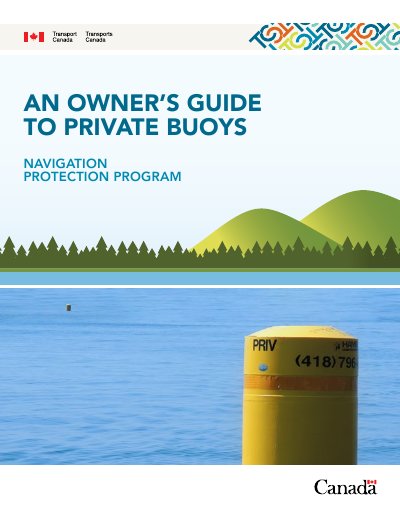
This Transport Canada Navigation Protection Program publication is an owner's guide to private buoys in Canada. It explains that buoys are floating markers used to communicate traffic channels, speed limits, mooring locations or hazards, and that the Private Buoy Regulations (PBR) apply to all private buoys placed as aids to navigation except those used to mark fishing gear. Buoy owners are responsible for following the PBR under the Canada Shipping Act, 2001, and owners and operators must also follow the Vessel Operation Restriction Regulations (VORR) where boating is restricted.
The guide covers compliance points and possible fines, the Canadian Navigable Waters Act and the treatment of mooring buoys as "works", the main principles of the VORR, and the Canadian Coast Guard's Canadian Aids to Navigation System. It then gives advice on buoy selection (lateral, cardinal and special buoys), sets out the responsibilities of private buoy owners, and shows illustrated examples of buoy types such as control buoys, followed by contact information.
| Private buoy identification marking | Must show "PRIV" on both sides, plus the buoy owner's contact information |
|---|---|
| Control buoy colour and markings | White with an orange, open faced circle on two opposite sides |
| Control buoy horizontal bands | Two orange horizontal bands, 40 mm minimum |
| Control buoy circle thickness | R/5, where R = the inner radius of the circle |
| Control buoy light | Yellow light if lighted; yellow retroreflective material if material is used |
| Lateral buoy types | Six types: port hand, starboard hand, port bifurcation, starboard bifurcation, fairway and isolated danger |
| Cardinal buoy types | Four: North, South, East and West |
The Private Buoy Regulations apply to all private buoys placed as aids to navigation, except those used to mark fishing gear, and buoy owners must follow them under the Canada Shipping Act, 2001. Where boating is restricted, owners and operators must also follow the Vessel Operation Restriction Regulations.
On March 29, 2004, responsibility for the enforcement and compliance provisions of the PBR passed from the Canadian Coast Guard to Transport Canada's Navigation Protection Program.
It must have "PRIV" on both sides and the contact information of the buoy owner; additional requirements vary by province.
Yes. Transport Canada considers mooring buoys as "works" under the CNWA on all navigable waters, so their placement is subject to review and approval unless excluded by TC policies and standards.
Yes, you can be fined for not meeting the requirements set out in the regulations and standards, and in the event of an accident owners may also be found liable for damages resulting from negligence.