
Datasheet for TP-Link’s L2/L2+ managed switches with static routing, QoS, security, and ISP features for enterprise and ISP networks.
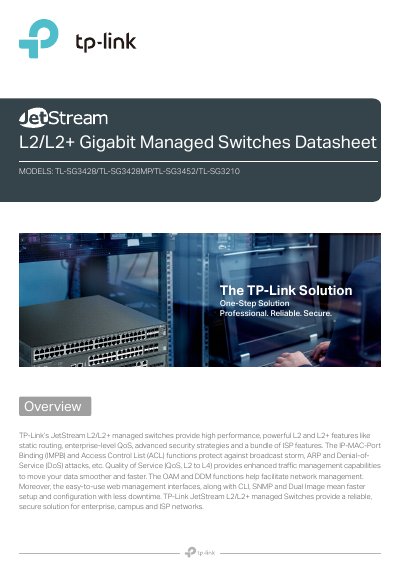
This datasheet details the TP-Link JetStream L2/L2+ managed switches, including models TL-SG3428, TL-SG3428MP, TL-SG3452, and TL-SG3210. These switches offer advanced networking features such as static routing, enterprise-level QoS, IP-MAC-Port Binding, ACLs, and support for IPv6. They are designed for enterprise, campus, and ISP networks with robust security and management tools including web GUI, CLI, SNMP, and dual image functionality.
The switches support various L2 and L2+ features including 802.1Q VLAN, STP/RSTP/MSTP, link aggregation, IGMP snooping, and loopback detection. They also include ISP features like 802.3ah OAM, DDM, sFlow, and QinQ. Hardware specifications vary by model, with port counts, switching capacity, and power consumption detailed for each. This manual is written in Chinese.
| Switching Capacity | 56 Gbps (TL-SG3428) |
|---|---|
| Packet Forwarding Rate | 41.66 Mpps (TL-SG3428) |
| MAC Address Table | 8K (TL-SG3428) |
| Number of Static Routers | 48 (IPv4, IPv6) |
| PoE Power Budget | 384 W (TL-SG3428) |
| Operating Temperature | 0 °C to 45 °C (TL-SG3428) |
| Dimensions (W x D x H) | 17.3 × 7.1 × 1.7 in (TL-SG3428) |
| Switching Capacity | 104 Gbps (TL-SG3452) |
| Packet Forwarding Rate | 77.38 Mpps (TL-SG3452) |
| MAC Address Table | 16K (TL-SG3452) |
| Switching Capacity | 20 Gbps (TL-SG3210) |
| Packet Forwarding Rate | 14.89 Mpps (TL-SG3210) |
| MAC Address Table | 8K (TL-SG3210) |
| Operating Temperature | 0 °C to 40 °C (TL-SG3452) |
| Dimensions (W x D x H) | 17.3 × 8.7 × 1.7 in (TL-SG3452) |
They offer IP-MAC-Port Binding, Port Security, Storm Control, DHCP Snooping, and Access Control Lists (ACL) to protect against broadcast storms, ARP attacks, and DoS attacks.
They support QoS from L2 to L4, with 8 priority queues, 802.1p CoS/DSCP priority, and queue scheduling including SP, WRR, and SP+WRR.
Features include 802.1Q VLAN, Port Mirroring, STP/RSTP/MSTP, Link Aggregation Control Protocol, Loopback Detection, Cable Diagnostics, IGMP Snooping, and static routing.
They support web-based GUI, CLI, SNMP (v1/v2c/v3), RMON, Dual Image, and Dual Configuration for easier management and improved reliability.