
TESCOM technical information on pressure regulator basics, covering PRV and BPR operation, loading mechanisms, and sensing elements.
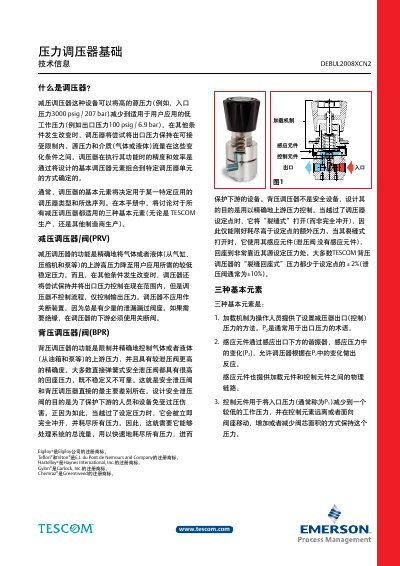
This technical information document explains the basic operation of pressure regulators. It describes pressure reducing regulators/valves (PRV) that reduce high upstream gas or liquid pressure to a lower stable outlet pressure, and backpressure regulators/valves (BPR) that limit and control upstream pressure with higher accuracy than a relief valve. The document notes that a regulator is not a shutoff device because a small amount of leakage always passes the seat.
It then covers the three basic elements—loading mechanism, sensing element, and control element—and describes four loading methods: spring loading, dome loading, air loading, and combined spring and dome loading. It also describes three sensing elements: diaphragm, piston, and bellows. Examples and pressure values are given for spring adjustment, dome loading, air loading, and combined spring/dome loading. This manual is written in Chinese.
| Example inlet pressure | 3000 psig / 207 bar |
|---|---|
| Example outlet pressure | 100 psig / 6.9 bar |
| Maximum outlet pressure with standard adjustment screw or hand knob | 500 psig / 34.5 bar |
| Maximum pressure with dark stem hand knob | 15,000 psig / 1034 bar |
| Manual adjustment torque | 30-40 in-lbs / 3.4-4.5 N•m |
| Air loading ratio range | 2.5:1 to 375:1 |
| Air loading maximum control pressure | ~80 psig / ~5.5 bar |
| Backpressure regulator crack-to-reseat accuracy | less than ±2% of setpoint |
It reduces high upstream gas or liquid pressure to a lower stable pressure required by the user application.
It limits and precisely controls upstream pressure; the document states that a backpressure regulator is not a safety device.
The loading mechanism, sensing element, and control element.
In air loading, the ratio of loading (pilot) pressure to control pressure is greater than 1:1.