
This guide explains the features and measurement differences of the TEGAM AVM-2000 null meter compared to earlier models.
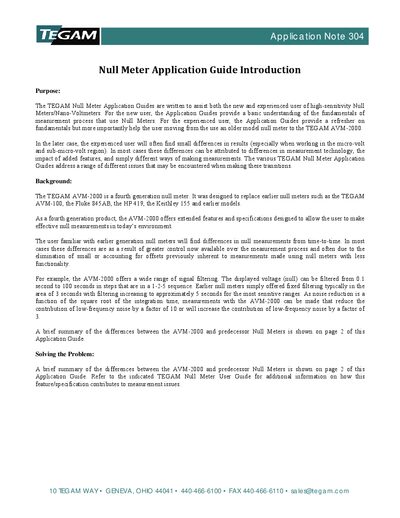
The TEGAM Null Meter Application Guide is written to help both new and experienced users understand the fundamentals of high‑sensitivity null‑meter measurements and to ease the transition from older models to the AVM‑2000. It outlines the reasons for measurement differences that can appear when moving from previous null meters to this fourth‑generation instrument.
Key differences highlighted include a selectable filtering range from 0.1 s to 100 s in 1‑2‑5 steps, separate zero‑adjustment functions for ZERO and OPERATE modes, user‑selectable input impedance values, and improved offset‑voltage handling. These enhancements give users greater control over noise reduction and measurement accuracy in the micro‑volt and sub‑micro‑volt regions.
| Filtering | Selectable 0.1 s – 100 s, 1‑2‑5 steps |
|---|---|
| Zero Function (Voltage) | Separate zero adjustment for ZERO and OPERATE modes per range |
| Input Impedance | User selectable: 1, 10, 100, 1000 MΩ to 1 mV |
| Offset Voltage | Offsets of ±10× “3s” range, ±30× “1s” range |
The AVM‑2000 offers selectable filtering from 0.1 second to 100 seconds in 1‑2‑5 steps.
It provides separate zero adjustment for ZERO and OPERATE modes for each range, with trimmed adjustments for various voltage spans.
Yes, the input impedance is user selectable among 1, 10, 100, and 1000 MΩ up to 1 mV.
The instrument allows offset adjustments of ±10× the “3 s” range and ±30× the “1 s” range.