
Technical datasheet for SST Sensing Optomax Industrial Series liquid level switches, detailing specifications, electrical interface, and ordering information.
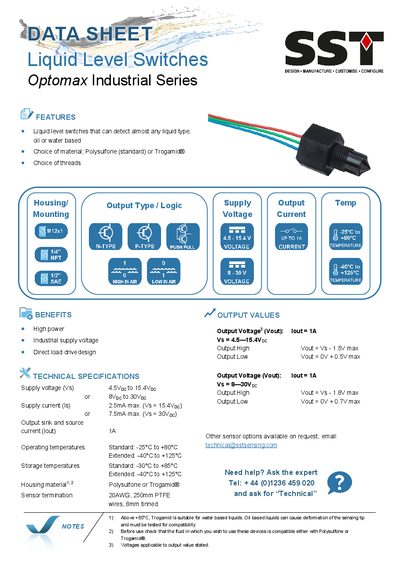
The Optomax Industrial Series liquid level switches from SST Sensing are designed to detect a wide range of liquids, including oil and water based fluids. They offer high‑power industrial supply voltage and a direct‑load drive design, with optional housing materials such as Polysulfone or Trogamid®.
Key specifications include a supply voltage of 4.5 V DC‑15.4 V DC (or 8 V‑30 V DC), a 1 A output current, and operating temperature ranges from –25 °C to +80 °C (standard) or –40 °C to +125 °C (extended). The datasheet also provides wiring diagrams, housing dimensions, and ordering codes for various thread and output configurations.
| Supply voltage | 4.5 V DC‑15.4 V DC or 8 V‑30 V DC |
|---|---|
| Supply current | 2.5 mA max (15.4 V) or 7.5 mA max (30 V) |
| Output current | 1 A |
| Operating temperature range | -25 °C to +80 °C (standard), -40 °C to +125 °C (extended) |
| Storage temperature range | -30 °C to +85 °C (standard), -40 °C to +125 °C (extended) |
| Housing material options | Polysulfone or Trogamid® |
It operates from 4.5 V DC to 15.4 V DC or from 8 V DC to 30 V DC, depending on the version.
The switches are offered with either Polysulfone (standard) or Trogamid® housing material.
The sensor can source or sink up to 1 A of output current.
Use alcohol‑based cleaning agents and avoid chlorinated solvents such as trichloroethane.