
This manual provides instructions for the installation, maintenance, and safety precautions of Sika Sikafloor-262AS, a two-component conductive epoxy coating.
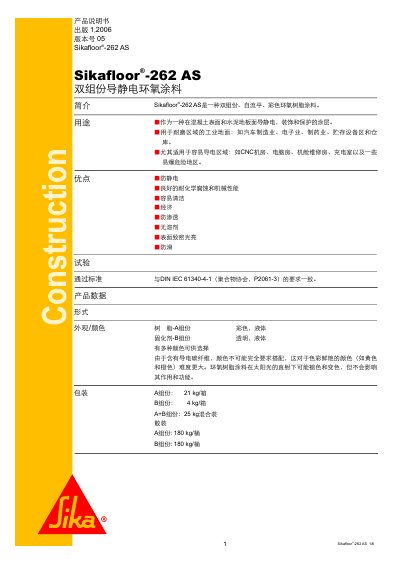
The document serves as a user guide for Sikafloor-262AS, a two-component, self-leveling, colored epoxy resin coating designed for concrete surfaces. It is intended for industrial flooring applications in areas requiring static dissipation and protection against chemical corrosion, such as automotive manufacturing, electronics, and pharmaceutical industries.
The manual details the product's technical data, including density, solid content, electrical resistance, and mechanical properties like compressive strength and hardness. It provides comprehensive instructions on surface preparation, mixing ratios (84:16 by weight), application methods for smooth or textured wear layers, drying times at various temperatures, and post-installation curing schedules. This manual is written in Chinese.
| Resin Density (20°C) | 1.70 kg/L |
|---|---|
| Hardener Density (20°C) | 1.03 kg/L |
| Mixing Ratio by Weight | 84:16 |
| Electrical Resistance Range | 10^9 - 10^5 Ohms |
| Compressive Strength (28 days, +23°C) | > 15 N/mm² |
The base and ambient temperatures must be at least +10°C.
It takes approximately 6 days for the floor to withstand light loads.
Yes, it is especially suitable for easily conductive areas including some explosive hazard zones.