
The SAS Outdoor Remote Control Airship User Manual explains the airship’s structure, ground equipment, setup steps, flight operation, and safety precautions.
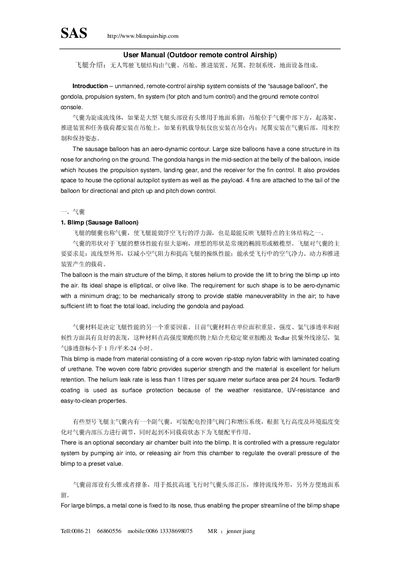
This manual describes the airship’s main components – the sausage‑shaped balloon, gondola, propulsion system, fin system, and ground control console – and provides detailed information on materials, helium retention, and optional secondary air chambers. It also covers the ground support equipment such as the anchoring post, gondola trolley, and helium‑filling tools.
Operational guidance includes pre‑flight preparation, helium filling, fin installation, battery and fuel setup, control‑channel configuration, take‑off, cruising, landing, and post‑flight checks. Safety tips address wind limits, battery monitoring, and proper handling of the propulsion and control systems. This manual is written in Chinese.
| Helium leak rate | < 1 litre per m² per 24 h |
|---|---|
| Engine type | Two 2‑stroke piston model aircraft engines |
| Battery | 12 V battery (multiple for >17 m models) |
| Fin deflection limit | ±45° |
| Fuel mixing ratio (summer) | 50 : 1 gasoline to oil |
The airship can be equipped with either three or four fins, arranged in a cross, X, or Y configuration.
Use a 50 : 1 gasoline‑to‑oil mix in summer and a 30 : 1 mix in winter; larger engines require 80 : 1 (summer) or 50 : 1 (winter).
Do not fly a gasoline‑engine airship when wind exceeds 9 m/s, and do not fly an electric‑engine airship when wind exceeds 5 m/s; avoid rain altogether.