
Datasheet for the SAGE Millimeter STA-60-08-D1 direct reading rotary vane attenuator covering 90 to 140 GHz with up to 60 dB attenuation.
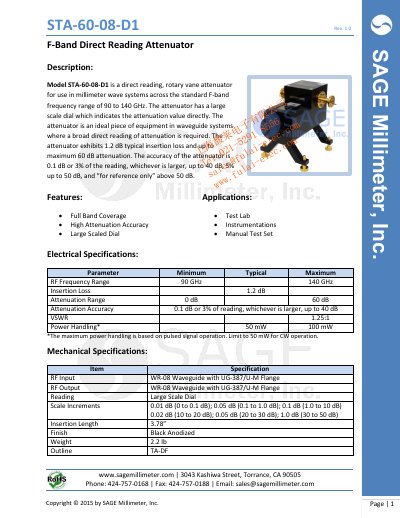
The SAGE Millimeter STA-60-08-D1 is a direct reading, rotary vane attenuator for millimeter wave systems across the standard F-band frequency range of 90 to 140 GHz. A large scale dial indicates the attenuation value directly for waveguide systems requiring a broad direct reading of attenuation.
The document lists electrical and mechanical specifications, including typical insertion loss, attenuation range and accuracy, VSWR, power handling, WR-08 waveguide flanges, scale increments, insertion length, finish, and weight. It also notes that phase shift changes while attenuation is varied and that attenuation flatness is ±2% or ±0.5 dB of the indicated value, whichever is greater, across the frequency band.
| RF Frequency Range | 90 GHz to 140 GHz |
|---|---|
| Insertion Loss | 1.2 dB typical |
| Attenuation Range | 0 dB to 60 dB |
| Attenuation Accuracy | 0.1 dB or 3% of reading, whichever is larger, up to 40 dB; 5% up to 50 dB; for reference only above 50 dB |
| VSWR | 1.25:1 |
| Power Handling | 50 mW minimum, 100 mW maximum (pulsed operation); limit to 50 mW for CW operation |
| RF Input | WR-08 Waveguide with UG-387/U-M Flange |
| RF Output | WR-08 Waveguide with UG-387/U-M Flange |
| Scale Increments | 0.01 dB (0 to 0.1 dB); 0.05 dB (0.1 to 1.0 dB); 0.1 dB (1.0 to 10 dB); 0.02 dB (10 to 20 dB); 0.05 dB (20 to 30 dB); 1.0 dB (30 to 50 dB) |
| Insertion Length | 3.78 in |
| Finish | Black Anodized |
| Weight | 2.2 lb |
| Attenuation Flatness | ±2% or ±0.5 dB of the indicated value, whichever is greater, for the frequency band |
It operates across the standard F-band frequency range of 90 to 140 GHz.
The attenuator uses a large scale dial that indicates the attenuation value directly.
Maximum attenuation is 60 dB. Accuracy is 0.1 dB or 3% of the reading, whichever is larger, up to 40 dB, 5% up to 50 dB, and for reference only above 50 dB.
No. The phase shift value changes while the attenuation is varied.