
The ROSEATE 2600 series capacitive level transmitter manual provides specifications, installation, wiring, calibration and operation instructions.
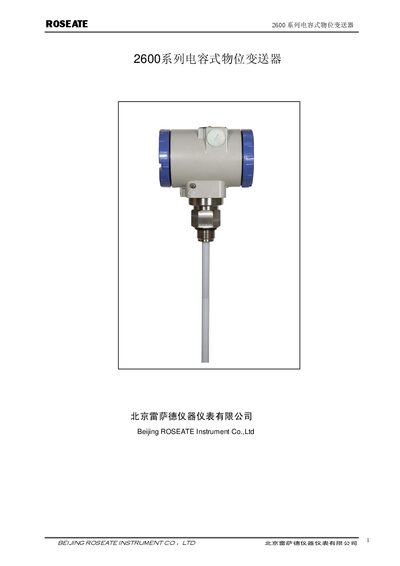
The 2600 series capacitive level transmitter from ROSEATE is designed for continuous level measurement of liquids and solid particles in containers, tanks, silos or hoppers. It can operate in harsh environments such as high/low temperature, high pressure, vacuum and strong‑corrosive media, and is used in industries like petrochemical, power, food, water treatment and metallurgy.
The manual covers the device’s working principle, technical specifications, available probe types, installation guidelines, electrical connection, calibration procedures, damping adjustment and storage recommendations. Detailed wiring diagrams, adjustment steps for zero and span, and selection advice for different media are included. This manual is written in Chinese.
| Power supply | 12~50 V DC |
|---|---|
| Input capacitance range | 10~4000 pF |
| Output signal | 4~20 mA DC |
| Linearity | 0.25 % |
| Temperature effect | 1 % per 50 °C full scale |
| Power‑supply variation effect | max 0.2 % |
| Load effect | max 0.2 % |
| Operating temperature range | -20 °C to +80 °C |
| Damping adjustment range | 200 ms to 3.6 s |
Turn potentiometer 1 until the output reads 4 mA, which sets the zero point.
Store the transmitter at +10 °C to +30 °C, 40 %–70 % RH in a well‑ventilated room without acids, bases or harmful gases.
Use a cable with a 6–7 mm diameter, tighten the terminal box cover and bolts, and the transmitter housing meets IP65 protection.