
Instructions for RiboBio C10310-1/-2/-3 EdU cell proliferation imaging kits, with Apollo dye staining and fluorescence microscopy protocols.
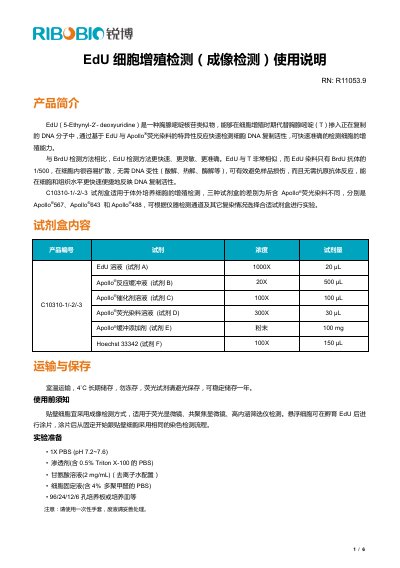
This instruction manual covers the RiboBio EdU cell proliferation imaging detection kits C10310-1, C10310-2 and C10310-3. EdU (5-Ethynyl-2'-deoxyuridine) is a thymidine analog incorporated into replicating DNA, and its specific reaction with Apollo fluorescent dye enables rapid, sensitive detection of DNA synthesis; compared with the BrdU method, it needs no DNA denaturation and no antigen-antibody reaction.
The document lists the kit contents and storage requirements, gives reference tables for EdU medium volumes, incubation times and Apollo staining reaction preparation, and provides a step-by-step fluorescence microscopy procedure for adherent cells (A549 cells in 96-well plates as example): EdU labeling, fixation, permeabilization, Apollo staining, optional Hoechst 33342 nuclear staining and image acquisition. The three kits differ only in the supplied Apollo dye (Apollo 567, 643 or 488). This manual is written in Chinese.
| EdU solution (Reagent A) concentration/volume | 1000X, 20 μL |
|---|---|
| Apollo reaction buffer (Reagent B) | 20X, 500 μL |
| Apollo catalyst solution (Reagent C) | 100X, 100 μL |
| Apollo fluorescent dye solution (Reagent D) | 300X, 30 μL |
| Hoechst 33342 (Reagent F) | 100X, 150 μL |
| C10310-1 dye / excitation / emission | Apollo 567, 550 nm / 565 nm |
| C10310-2 dye / excitation / emission | Apollo 643, 653 nm / 667 nm |
| C10310-3 dye / excitation / emission | Apollo 488, 490 nm / 520 nm |
EdU (5-Ethynyl-2'-deoxyuridine) is a thymidine analog that replaces thymidine and is incorporated into DNA being replicated during cell proliferation; a specific reaction with Apollo fluorescent dye then detects DNA synthesis activity.
They differ only in the Apollo fluorescent dye included: Apollo 567, Apollo 643 and Apollo 488 respectively, so the kit is chosen according to the detection channel and counterstaining needs.
Yes; after EdU incubation suspension cells can be smeared onto slides and then processed from fixation onward with the same staining procedure used for adherent cells.
Transport at room temperature and store long term at 4°C; do not freeze, protect fluorescent reagents from light, and the reagents remain stable for one year.