
Technical datasheet for the Ratchet G4Q relay featuring a unique ratchet mechanism for positive alternate transfer/switching operation.
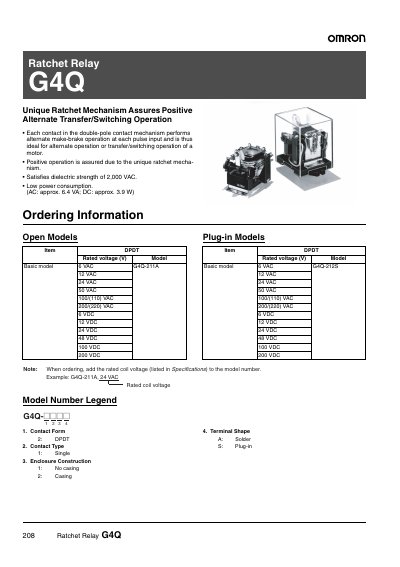
The Ratchet G4Q relay is designed for positive alternate transfer or switching operations of a motor. Its unique ratchet mechanism ensures that each contact in the double-pole contact mechanism performs alternate make-break operation at each pulse input. The device satisfies a dielectric strength of 2,000 VAC and features low power consumption, with AC consumption of approximately 6.4 VA and DC consumption of approximately 3.9 W.
| Dielectric Strength | 2,000 VAC |
|---|---|
| AC Power Consumption | approx. 6.4 VA |
| DC Power Consumption | approx. 3.9 W |
| Contact Material | Silver alloy |
| Rated Load (Resistive) | 5 A at 220 VAC |
| Max. Switching Voltage | 250 VAC, 250 VDC |
| Max. Switching Current | 5 A |
| Electrical Endurance | 500,000 operations min. |
| Operating Temperature | -10 °C to 55 °C |
It is ideal for alternate operation or transfer/switching operation of a motor due to its unique ratchet mechanism.
Positive operation is assured due to the unique ratchet mechanism within the relay.
The maximum operating frequency is 1,200 operations per hour for both mechanical and electrical endurance.