
PPA Volt Gate no-break technical manual for automatic gates: electrical connections, cable sizes, specifications and LED/audible signals.
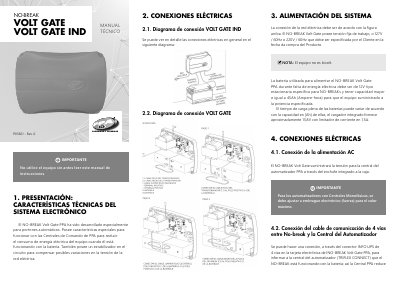
The PPA Volt Gate is a no-break (UPS) developed for automatic gates that works with PPA command centers to reduce the power consumed by the system when it runs on battery; the circuit also includes a stabilizer to compensate for variations in the mains voltage. The equipment has a fixed working voltage, either 127 V/60 Hz or 220 V/60 Hz, which the customer must specify at the time of purchase because the unit is not bivolt.
The manual shows the connection diagrams, how the AC supply reaches the gate operator's control board through the plug integrated in the enclosure, and the 4-way INFO UPS and 2-way INFO communication connections that tell the control board the no-break is running on battery. It also gives a table of minimum cable cross-sections for distances up to 20 m, the electrical specifications of the Volt Gate and Volt Gate IND models, and the meaning of the green, red and blue LEDs and the audible beeps. This manual is written in Spanish.
| Working voltage (fixed, not bivolt) | 127 V / 60 Hz or 220 V / 60 Hz |
|---|---|
| Rated power, Volt Gate 127 V / 220 V | 350 VA |
| Maximum power for 5 seconds, Volt Gate 127 V / 220 V | 700 VA |
| Battery voltage, Volt Gate 127 V / 220 V | 24 V |
| Rated power, Volt Gate IND 127 V / 220 V | 550 VA |
| Integrated battery charger | Approximately 13.8 V output, current limited at 1.5 A |
| Minimum battery capacity | 12 V stationary battery, 45 Ah or more |
| Maximum communication cable length | 20 m |
| Minimum cable cross-section up to 10 m | 0.3 mm² signal cable, 1.5 mm² power cable |
| Minimum cable cross-section from 10 m to 20 m | 0.5 mm² signal cable, 2.5 mm² power cable |
No. It has a fixed working voltage of either 127 V/60 Hz or 220 V/60 Hz, which must be specified by the customer when the product is purchased.
The communication cable between the no-break PPA and the control board must be 20 meters or less.
The red LED is on and the unit emits a beep whose frequency increases as the battery voltage starts to drop.