
Panasonic usage precautions for non-solid aluminum electrolytic capacitors, covering design, polarity, voltage, ripple current, temperature, life, mounting…
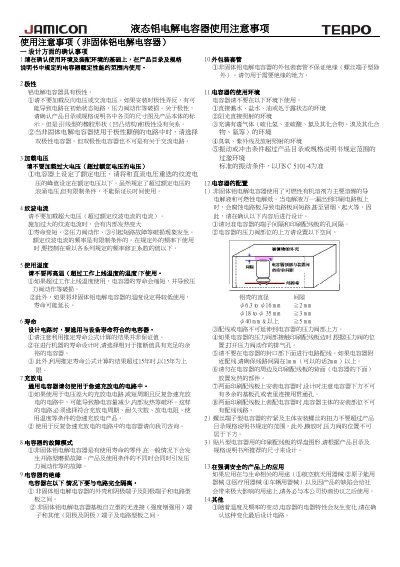
This document gives usage precautions for Panasonic non-solid aluminum electrolytic capacitors. It explains design confirmation items and handling rules, including polarity, applied voltage, ripple current, operating temperature, estimated life, charge and discharge, failure modes, insulation, and use environment.
The second part covers installation and soldering: mounting, soldering heat resistance, lead-free reflow conditions for surface-mount types, post-soldering handling, and printed circuit board cleaning. It also lists conditions to avoid, such as reverse voltage, excessive ripple current, and cleaning agents that may damage the capacitor. This manual is written in Chinese.
| Pressure relief valve clearance (φ6.3–φ16 mm) | 2 mm or more |
|---|---|
| Pressure relief valve clearance (φ18–φ35 mm) | 3 mm or more |
| Pressure relief valve clearance (φ40 mm and above) | 5 mm or more |
| Reflow preheat condition | 160–190°C, 120 s max |
| Wiring clearance near capacitor | 1 mm or more (2 mm preferred) |
No. The document says not to apply reverse voltage or AC voltage; reversed polarity can cause the circuit to short at the initial state or the pressure relief valve to operate.
Excessive ripple current can shorten life, operate the pressure relief valve, and cause short-circuit failure.
No, except for screw-terminal types, the outer sleeve is not guaranteed to insulate and should not be used where insulation is required.
Discharge it through a resistor of about 1 kΩ.