
A guide to performing Bosch deep silicon etching on the Oxford Instruments ICPRIE, including process mechanics, characteristics, and a standard recipe.
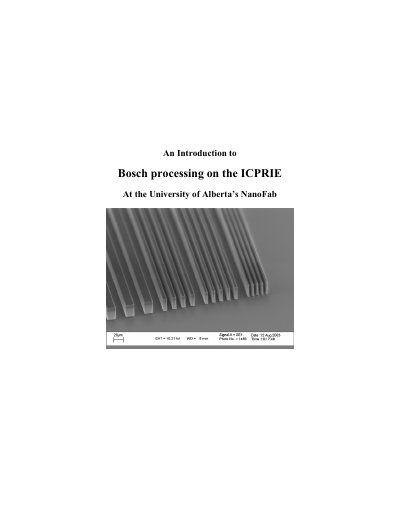
This document introduces the Bosch process for deep silicon etching as implemented at the University of Alberta's NanoFab using the Oxford Instruments ICPRIE. It explains the two-step plasma mechanism alternating between etching with SF6 and deposition with C4F8 to create anisotropic profiles with vertical sidewalls. The text details the advantages of this dry etch method, such as independence from crystal orientation, and discusses key characteristics like etch rate, uniformity, and mask selectivity.
| Etch Rate Range | 1.33 to 3 microns per minute |
|---|---|
| Standard Etch Rate | 2.33 microns per minute |
| Mask Selectivity (Photoresist) | 20:1 |
| Mask Selectivity (Silicon Dioxide) | 100:1 |
| Deposition Step Duration | 9 seconds |
| Etch Step Duration | 9 seconds |
It etches independently of the crystal orientation, producing square walls and channels regardless of the silicon crystal orientation.
The system pumps for 1 minute to reach base pressure before beginning processing.