
Chinese user manual for the Nanbeichao QDK automatic dynamic anti-cracking tester: application, working principle, specifications and test steps for…
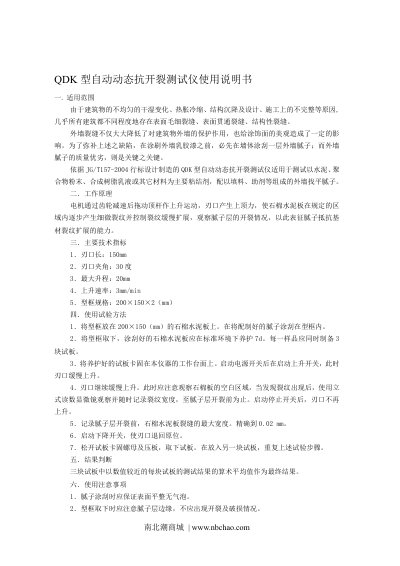
This is the Chinese user manual for the Nanbeichao QDK automatic dynamic anti-cracking tester, an instrument designed and built according to the JG/T157-2004 industry standard for testing exterior wall leveling putty. The putty may use cement, polymer powder, synthetic resin emulsion or other materials as the main binder together with fillers and additives.
The manual explains the working principle: a motor drives a push rod upward through a gear reducer so that a blade edge applies an upward force, gradually producing fine cracks in an asbestos cement board and slowly extending them, so the cracking of the putty layer can be observed. It then gives the main technical specifications, the test procedure (frame, putty application, 7-day curing, three test boards per sample, blade rise and reading with a microscope, blade return), how the result is judged from the three boards, and precautions for use. This manual is written in Chinese.
| Blade edge length | 150 mm |
|---|---|
| Blade edge angle | 30 degrees |
| Maximum lifting stroke | 20 mm |
| Rising rate | 3 mm/min |
| Frame size | 200 × 150 × 2 mm |
| Design standard | JG/T157-2004 |
| Crack width reading precision | 0.02 mm |
It is used to test exterior wall leveling putty whose main binder is cement, polymer powder, synthetic resin emulsion or other materials, together with fillers and additives.
The blade edge rises at a rate of 3 mm/min, with a maximum lifting stroke of 20 mm.
Three test boards should be prepared at the same time for each sample and cured in a standard environment for 7 days.
The arithmetic mean of the test results of the three boards whose values are closest to each other is taken as the final result.