
Product leaflet for Mitsubishi Materials NTC thermistor 55, detailing resistance-temperature characteristics, B-value calculation, and usage precautions.
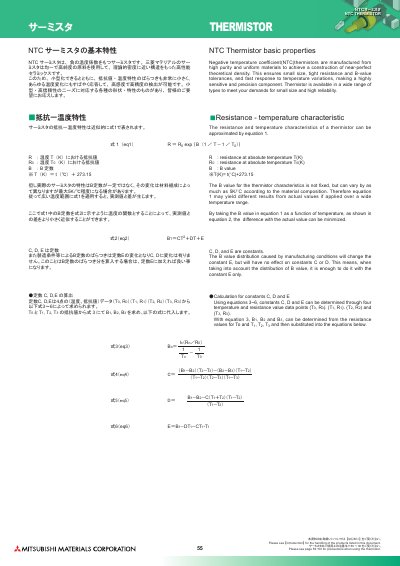
This document explains the basic properties of Mitsubishi Materials' NTC thermistors, including resistance-temperature characteristics and B-value calculation methods. It covers how resistance changes with temperature and how to calculate B-values for accurate performance. The document also includes practical examples and formulas for calculating resistance at various temperatures, along with definitions of key parameters like resistance-temperature coefficient and heat dissipation constant. It is intended for users who need precise temperature sensing applications.
The thermistors are made from high-purity materials with near-theoretical density, enabling small size, low resistance variation, and high sensitivity. The document provides formulas for calculating constants C, D, and E from four temperature-resistance data points, and includes practical examples for calculating resistance over a temperature range. This manual is written in Japanese.
| B-Value Deviation | 50 K |
|---|---|
| Temperature Range | 10°C to 30°C |
| Measurement Conditions | 25°C in still air |
The B-value is calculated using constants C, D, and E derived from four temperature-resistance data points, with equations 3 to 6 provided in the document.
The resistance-temperature coefficient (α) is the rate of change of zero-power resistance per 1°C temperature change, derived by differentiating the resistance-temperature equation.
The heat dissipation constant (δ) is the power required to raise the thermistor's temperature by 1°C through self-heating in thermal equilibrium.