
Chinese-language safety data sheet (SDS) for Meyer-Glitza ENGINE OIL 10W-60 fully synthetic engine oil, covering hazards, first aid, handling and disposal.
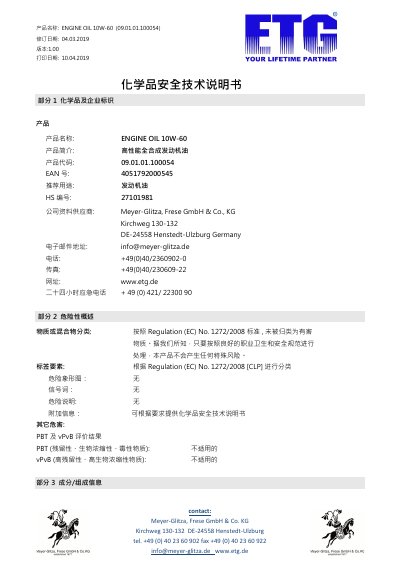
This document is the chemical safety data sheet (化学品安全技术说明书) for Meyer-Glitza ENGINE OIL 10W-60, a fully synthetic high-performance engine oil (高性能全合成发动机油) with product code 09.01.01.100054 and EAN 4051792000545. The supplier is Meyer-Glitza, Frese GmbH & Co. KG, based in Henstedt-Ulzburg, Germany.
The sheet follows the standard 16-section SDS structure. Under Regulation (EC) No. 1272/2008 [CLP] the product is not classified as a hazardous substance. The main components are Fischer-Tropsch distillates (70-90%) and alkarylamine (1-3%). Sections cover first aid, fire-fighting measures, spill response, safe handling and storage, personal protective equipment, physical and chemical properties, toxicological and ecological information, disposal and transport. This manual is written in Chinese.
| Product type | Fully synthetic high-performance engine oil |
|---|---|
| Physical form | Liquid, yellow, characteristic odor |
| Flash point | 250 °C |
| Pour point / melting point | -42 °C |
| Initial boiling point | > 280 °C |
| Kinematic viscosity at 40 °C | 160.1 mm²/s |
| Density (20 °C) | 0.8458 g/cm³ |
| Solubility | Insoluble or not miscible |
No. According to Regulation (EC) No. 1272/2008 [CLP], the product is not classified as a hazardous substance and no hazard pictograms, signal words or hazard statements apply.
Use foam, dry chemical powder or carbon dioxide extinguishers, or apply water spray.
Nitrile rubber gloves tested to EN 374, such as KCL Camatril (0.33 mm, breakthrough time > 480 minutes) for permanent contact or Dermatril (0.11 mm, 30 minutes) for short contact.
Collect it with absorbent materials such as sand, sawdust, universal binder or diatomaceous earth, and dispose of the collected waste as hazardous waste. Prevent it from entering drains or waterways.