
The ManuFlo ME5IC interface card manual provides installation, wiring, operation, specifications, and troubleshooting for connecting ME995 batch controllers…
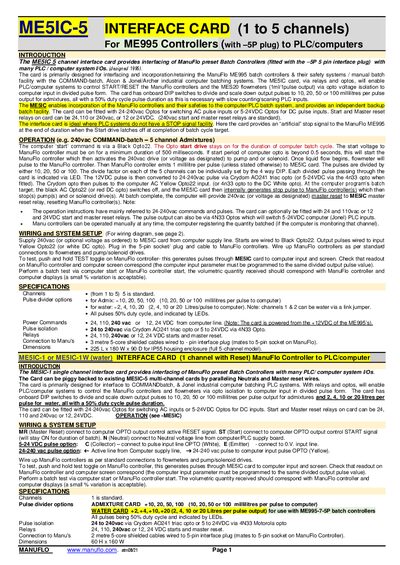
The ME5IC interface card enables integration of ManuFlo ME995 batch controllers with PLC or computer systems, providing start/reset control and pulse output for flowmeters. The card supports both admix and water applications with selectable pulse division and multiple voltage options.
The manual includes an introduction, detailed wiring and system setup, specifications, installation guidance, and a troubleshooting guide, as well as ordering option codes and dimensions for the IP55‑rated enclosure.
| Pulse divider (admix) | 10, 20, 50, 100 ml per pulse |
|---|---|
| Pulse divider (water) | 2, 4, 10, 20 L per pulse |
| Power voltage options | 24, 110, 240 VAC or 12, 24 VDC |
| Pulse duty cycle | 50 % duty cycle |
| LED indicators | Pulse status indicated by LEDs |
| Cable length | 3 metre 5‑core shielded cable |
| Dimensions (full 5‑channel model) | 225 L × 180 W × 90 D mm |
| Dimensions (single‑channel model) | 60 H × 160 W mm |
| Pulse isolation method | 24‑240 VAC via Crydom AO241 triac opto or 5‑24 VDC via 4N33 opto |
On‑board DIP switches divide pulses to 10, 20, 50 or 100 ml per pulse for admixtures, or 2, 4, 10, 20 L per pulse for water.
Each divided pulse is indicated by an LED, and all pulses have a 50 % duty cycle.