
The LYSOL IC™ Disinfectant Spray MSDS provides hazard, handling, storage, and regulatory information for safe use.
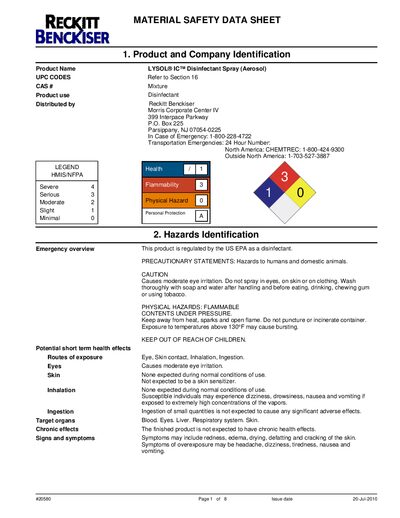
This Material Safety Data Sheet (MSDS) describes LYSOL IC™ Disinfectant Spray (Aerosol), a flammable aerosol disinfectant distributed by Reckitt Benckiser. It lists product identification, composition, and regulatory registration details.
Key safety information includes moderate eye irritation, flammable contents under pressure, recommended personal protective equipment, storage away from heat and open flame, and proper disposal methods. The sheet also provides first‑aid procedures, fire‑fighting measures, and transport regulations.
| Physical state | Gas |
|---|---|
| pH | 10 (Basic) |
| Vapor pressure | 95 - 105 psig |
| Vapor density | > 1 |
| Specific gravity | 0.835 @ 25°C |
| Flammability limit (lower) | 3.3 % vol |
| Flammability limit (upper) | 19 % vol |
The product causes moderate eye irritation and contains flammable contents under pressure, so it must be kept away from heat, sparks, and open flame.
Eliminate ignition sources and absorb the spilled material with a non‑flammable absorbent such as sand or vermiculite.
Eye/face protection is advised; hand and skin protection are not normally required when used as directed, but full protective clothing is recommended for emergency responders.