
A guide explaining how metal detectors work, covering balanced coil systems, sensitivity settings, testing procedures, and maintenance for food manufacturing.
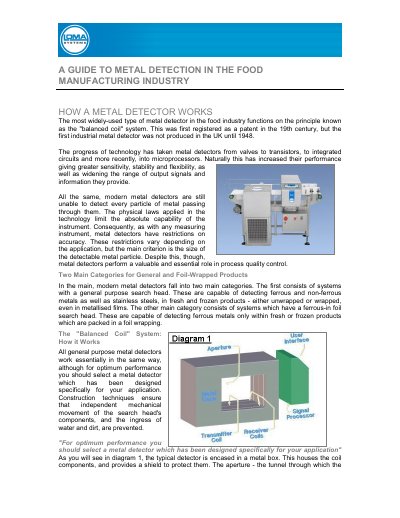
This document explains the principles of metal detection in the food industry, focusing on the 'balanced coil' system used for general and foil-wrapped products. It details how the system illuminates metal particles using transmitter and receiver coils to detect ferrous, non-ferrous, and stainless steel contaminants.
| Detection Principle | Balanced coil system |
|---|---|
| Ferrous Detection (Up to 50mm) | 1.0mm |
| Ferrous Detection (Up to 125mm) | 1.5mm |
| Ferrous Detection (Up to 200mm) | 2.0mm |
The three main groups are Ferrous, Non-Ferrous, and Stainless steel.
The two most common grades used are 304(L) and 316.