
This guide explains the operation, features, typical applications, parameters and selection considerations for JMWSEMI Thyristor Surge Suppressors.
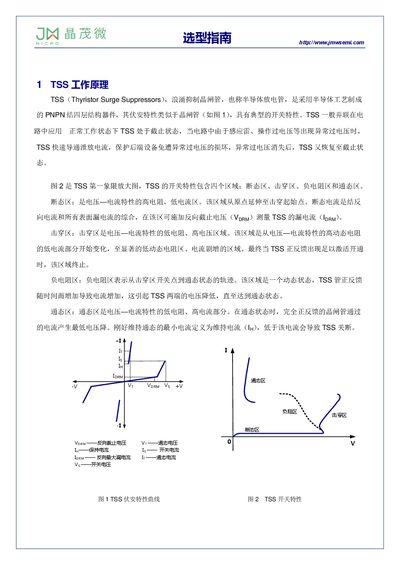
The document introduces the working principle of Thyristor Surge Suppressors (TSS), describing their PNPN structure, switching characteristics and how they protect downstream equipment by quickly conducting during over‑voltage events.
It then details key specifications such as reverse blocking voltage, junction capacitance, surge current capability, and provides typical application circuits, test methods, and practical selection tips including voltage rating, package type and clamping considerations. This manual is written in Chinese.
| Junction capacitance | tens to over 100 pF |
|---|---|
| Reverse blocking voltage (VDRM) range | 6 V–620 V |
| Peak pulse voltage (VPP) | up to 6 kV (10/700 µs waveform) |
VDRM is the reverse blocking voltage, also called the repetitive peak voltage in the off state, representing the highest instantaneous voltage the device must withstand.
TSS are widely used for communication line protection in communication, security and industrial electronic products.
IH is measured using the test circuit shown in Figure 6, where the device is driven into the on state and the current is reduced until the device turns off.