
User manual for the YL-1278RF low‑power spread‑spectrum wireless module covering features, hardware design, SPI interface and troubleshooting.
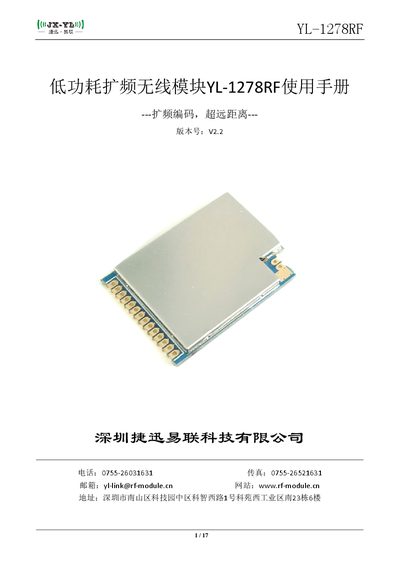
The YL-1278RF is a low‑power, long‑range wireless module based on LoRa™ spread‑spectrum modulation. It operates in the 420‑450 MHz band (customizable) and supports half‑duplex communication via a standard 4‑wire SPI interface. The manual provides a complete product overview, pin definitions, technical parameters, hardware design guidelines, and reference software code.
Key sections include SPI timing, TX/RX control, GPIO configuration, antenna selection, usage notes, and a detailed troubleshooting guide to help designers integrate the module into IoT, smart‑home, and industrial automation applications. This manual is written in Chinese.
| Modulation | LoRa™ spread‑spectrum |
|---|---|
| Operating Frequency | 420~450 MHz (customizable) |
| Transmit Power | 20 dBm |
| Receive Sensitivity | -148 dBm |
| Supply Voltage | 2.1 V – 3.6 V |
| Transmit Current | ≤120 mA |
| Receive Current | ≤9.9 mA |
| Sleep Current | ≤1 µA |
| Operating Temperature | -40 °C – +80 °C |
| Operating Humidity | 10 % – 90 % RH (non‑condensing) |
The module operates in the 420 MHz to 450 MHz band, and other bands can be customized.
In transmit mode the module draws up to 120 mA.
The antenna should have a 50 Ω impedance and a VSWR less than 1.4.
The REST pin is active low; pulling it low resets the module, after which it must be kept high for normal operation.