
User manual for the ISP LANKONT-001 LAN Controller, a network board with web management, 5 outputs, sensors, events, scheduler, watchdog and PWM.
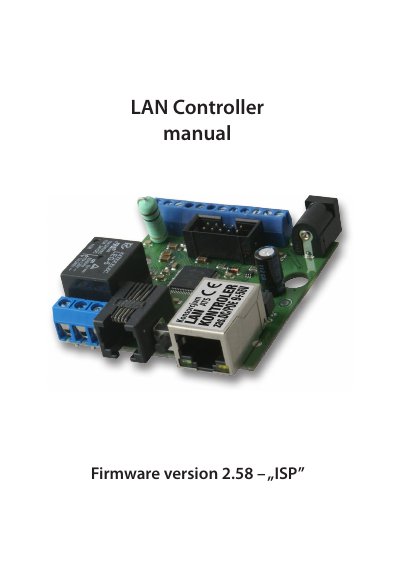
This manual describes the ISP LANKONT-001 LAN Controller, a small network board that works as a web server showing sensor readings and allowing remote control of up to 5 outputs. It supports WWW or SNMP v2 management, a user-programmable Events Config panel, a Scheduler for switching outputs at set times, an IP watchdog for up to 5 network devices, and a PWM output for controlling light brightness or motor speed. The board can be powered by 8–56 V DC or passive PoE, and firmware can be upgraded via TFTP.
The document covers the board's pins and components, relay bond wiring, sensor connections (NTC 10K, KTY-84, PT1000, DS18B20 on a 1-Wire bus, voltage and current inputs), the WWW control panel, Events Config, XML data reading and HTTP commands for switching outputs and setting PWM frequency and duty. Stated applications include server room monitoring, home automation, heating and solar installations, and renewable energy measurements.
| Supply voltage | 8–56 V DC |
|---|---|
| Power consumption | about 1 W |
| PoE supply | Yes, passive |
| Interface | Ethernet 10 Mbit/s |
| Relay contact rating | 255 VAC 10 A |
| Operating temperature | –20 to +85 °C |
| Weight | 45 g (without casing) |
| Dimensions | 57 x 67 mm |
| PWM output range | 2.6 kHz to 4 MHz |
| Supported temperature sensors | NTC10K B=3950, KTY-84, PT1000 |
| 1-Wire bus sensors | DS18B20, max 4 sensors |
| Default IP address | 192.168.1.100 |
The default user and password is "admin" and the default IP address is 192.168.1.100.
The board acts as a web server and allows you to remotely control up to 5 outputs, including one onboard relay.
Hold the reset button about 5 seconds to reset the module; holding it about 10 seconds sets all settings to default, confirmed by the relay quickly switching on/off.
Yes, commands such as IP/outs.cgi?out=xxxxx toggle outputs and IP/outs.cgi?OUTX=x enables or disables a specific output, with user:password@ authentication when a password is set.