
Illustrated guide to waveforms, sync, modulation, and sound design for the Intellijel RUBICON synthesizer module.
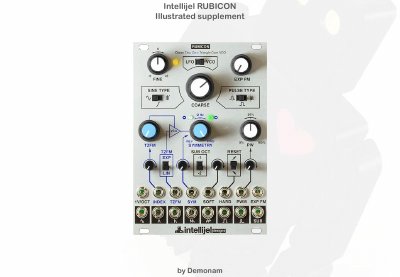
This supplement provides detailed visual explanations of the RUBICON’s waveform generation, sync modes, and modulation techniques. It covers SINE TYPE, PULSE TYPE, Pulse Width Modulation, SUB OCTAVE, SOFT and HARD sync, LFO mode, and TZFM. Each section includes charts, diagrams, and practical examples to help users understand and apply these features in sound design.
The guide is structured for hands-on use, with sections on waveform shapes, sync behavior, modulation depth, and advanced techniques like TZFM and space-folding. It includes practical tips from contributors like David G. Dixon and Danjel Van Tijn, making it ideal for synthesizer enthusiasts and musicians looking to explore the RUBICON’s capabilities.
The RUBICON generates SINE, SIGMOID, SQUARE, ZIG-ZAG, PULSE, SUB OCTAVE, TRIANGLE, and SAW waveforms.
SOFT sync reverses the triangle wave on incoming sync pulses, with probability controlled by an attenuator. It requires edge-y waveforms like square or sawtooth.
Yes, by patching a modulation source into the hard sync input and using the TZFM input, you can control wavefolding via the symmetry knob and exp/lin switch.