
INDEECO troubleshooting guide for duct heaters: causes and remedies for no heat, low output, overheating, terminal problems and contactor chatter.
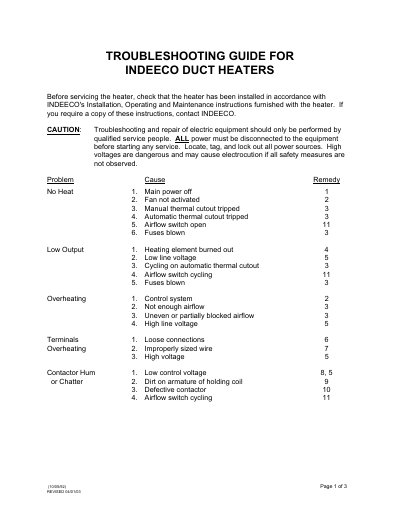
This three-page troubleshooting guide from INDEECO lists common problems with INDEECO duct heaters, their possible causes and the numbered remedies that match each cause. Covered problems are no heat, low output, overheating, terminal overheating and contactor hum or chatter.
The guide opens with a caution that only qualified service people should troubleshoot and repair the equipment and that all power must be disconnected, tagged and locked out before service. The remedy section explains checks on the main power disconnect, fan interlocks, thermal cutouts, fuses, heating elements, line voltage, wiring and the airflow switch, and gives formulas for element resistance and wattage. Contact details for INDEECO in St. Louis, Missouri are printed on the last page.
| Minimum duct air pressure to close airflow switch | at least 0.07" WC |
|---|---|
| Minimum control voltage | not less than 90% of the contactor coil voltage |
All power must be disconnected, and all power sources must be located, tagged and locked out before any service work begins.
Air pressure in the duct must be at least 0.07" WC to close the switch before the heater will operate.
All terminals should be checked and tightened once a year or at the start of every heating season.
Disconnect the power wiring to the elements and connect a reliable ohmmeter to the element terminals; replace the element if it is open or shorted to ground.