
Guide to creating window blinds with HP Latex 2700 and 2700W printers, covering substrates, setup, printing, finishing, and installation.
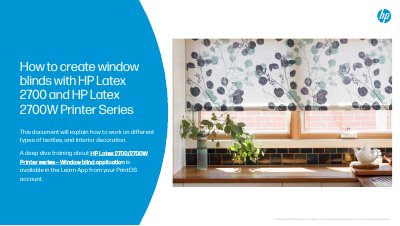
HP Latex 2700 and 2700W Printer Series can be used to print window blinds on flexible textile substrates such as polyester fabrics, PVC screens, and natural fibers. The guide covers substrate selection, preparation, job setup, printing, and post-print finishing.
It describes durable textile requirements including dry rub resistance testing, substrate preset and porosity checks, RIP-based image sizing and tiling, ink collector use for porous fabrics, cutting, sewing or welding, and installation of several blind types.
Polyester fabrics, PVC screens, and other materials such as cotton or natural fibers.
It should be installed when the fabric is porous.
It is measured according to ISO 105-X12 using the Taber Linear Abraser with crock tool and cotton fabric as abrader.
Frontlits 6p130ink or 10p170ink.