
The manual provides safety, installation, operation, maintenance and troubleshooting instructions for the Hohner CHM-xxx Series Geolograph Air Line Retriever.
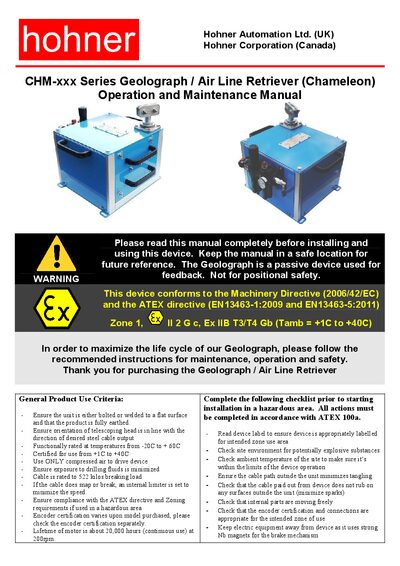
The Geolograph Air Line Retriever is a passive device used for cable handling on drilling rigs. It complies with Machinery Directive 2006/42/EC and ATEX zones 1, II 2 Gc, Ex IIB T3/T4 Gb, and must be installed on a flat, grounded surface.
The document covers installation steps, normal usage, failure modes, routine maintenance, shutdown procedures, technical data, troubleshooting and a full exploded parts list, helping qualified personnel keep the unit safe and operational.
| Weight | <50 kg |
|---|---|
| Recommended Air Supply | 4–7 bar (max) |
| Cable break load | 552 kg |
| Operating temperature range | -20 °C to +60 °C |
| Structure material | Aluminum |
| Dimensions (L×W×H) | 400 mm × 465 mm × 315 mm |
| Motor lifetime | ≈20 000 h continuous at 200 rpm |
The device should be supplied with compressed air between 4 and 7 bar, with 4 bar being the typical operating pressure.
The timing belt should be inspected and, if necessary, replaced at least every six months to ensure safe operation.
Ensure the unit is bolted or welded to a flat surface, fully earthing it, verify ATEX zone compliance, and confirm the cable path is clear of obstacles before connecting air and power.