
The Hai Li Chuang Audio Power Amplifier Selection Guide (2023 Q1) lists specifications, output modes, voltage options and feature comparisons for a range of…
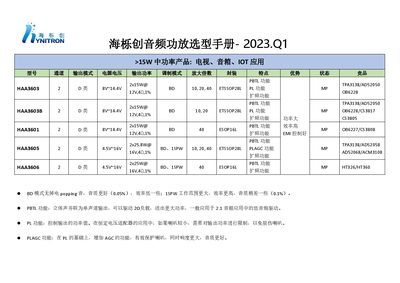
This guide provides a comprehensive overview of Hai Li Chuang’s audio power amplifier portfolio, organized by power class and target application. It includes mid‑power (>15 W) products for TVs, speakers and IoT, low‑power (<15 W) units for small speakers, toys and appliances, and ultra‑low‑power amplifiers for portable devices such as watches and smartphones.
Each product entry details channel output mode, supply voltage range, output power, modulation mode, package type, key features and advantages, as well as a brief competitor comparison. Functional notes explain special modes like PBTL, PL, PLAGC, dual‑mode control, dynamic boost and current limiting. This manual is written in Chinese.
| HAA3603 Output Power | 2×15 W @12 V, 4 Ω, 1 %BD |
|---|---|
| HAA9809 Input Voltage Range | 2.8 V ~ 5.5 V |
| HAA9003 Output Power | 2.5 W @4.2 V, 8 Ω, 10 % charge‑pump |
PBTL allows stereo channels to be paralleled into a single mono output, enabling 2 Ω load driving and higher power, typically used for sub‑woofer drivers in 2.1 speaker systems.
PLAGC adds automatic gain control to the PL function, protecting speakers while delivering greater loudness and better sound quality.
Dual‑mode control combines voltage selection and pulse‑input control, allowing dynamic boost and current‑limiting to improve efficiency and protect low‑voltage batteries.