
The HAEFELY 2914 test cell is used for dielectric tests on solid insulants, determining dissipation factor, relative permittivity and specific resistivity.
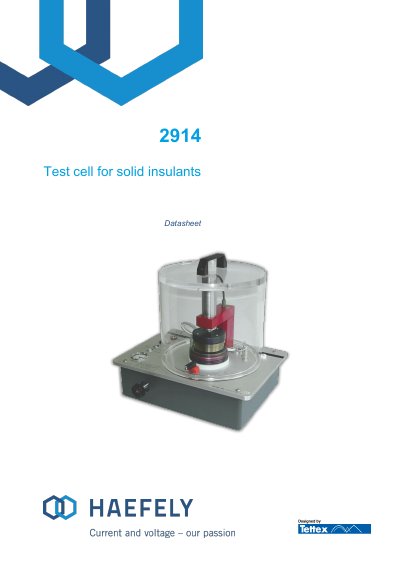
The HAEFELY 2914 is a test cell for solid insulants used with the 2830/2831 measuring bridge. It determines dissipation factor tan δ and relative permittivity εr on solid insulators such as paper and plastic foils, as well as specific resistivity. A shielded measuring electrode with guard ring eliminates stray capacitances, and the design follows ASTM, IEC and ISO standards and CIGRE recommendations.
Both electrodes can be heated, and the upper electrode is moved vertically by a manual and external hydraulic system; pressure is indicated by an embedded manometer. The cell includes a protective cover, vacuum and protective-gas connections, a safety switch, sockets for the measuring bridge and power supply, and a temperature indication output. Technical data list electrode surface 20 cm², electrode diameter 49.5 mm, heating capacity 1260 W, electrode temperature ambient to +200 °C, electrode pressure 0...10 N/cm² and maximum test voltage 2000 V RMS at 50/60 Hz.
| Measurement frequency | 50 and 60 Hz (with 2831); up to 100 kHz typically |
|---|---|
| Electrode surface | 20 cm2 |
| Electrode diameter | 49.5 mm |
| Electrode material | Stainless steel, hardened, lapped |
| Heating capacity | 2 heating plates of 630 W each, 1260 W together |
| Electrode temperature | Ambient to +200 °C |
| Electrode pressure | 0...10 N/cm2, adjustable |
| Max. test voltage | 2000 V RMS, 50/60 Hz |
| Test cell evacuation | Up to 0.15 mbar |
| Dimensions | 380 x 430 x 450 mm (15 x 16.9 x 17.7 in) |
| Weight | 19.4 kg (42.8 lbs) |
| Protection class | IP 50 |
The HAEFELY 2914 is used for dielectric tests on solid test samples together with the 2830/2831 measuring bridge.
The maximum test voltage is 2000 V RMS at 50/60 Hz.
The electrode pressure is adjustable from 0 to 10 N/cm2.
The electrodes can be heated from ambient to +200 °C.