
Green Mountain Club 2nd Edition Backcountry Sanitation Manual

The Green Mountain Club 2nd Edition Backcountry Sanitation Manual guides backcountry sanitation management, covering privies, composting, health and safety…
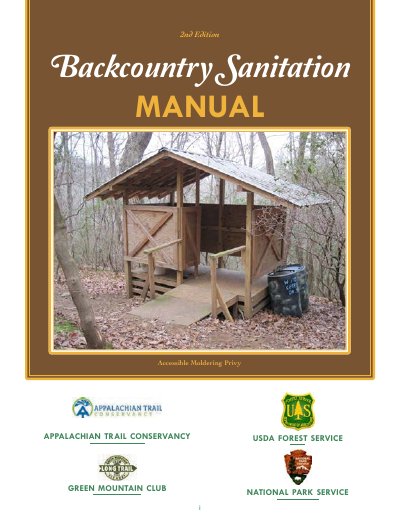

Green Mountain Club 2nd Edition Backcountry Sanitation Manual - cover page
Brand
Green Mountain Club
Category
Other
Document type
Other
Language
English
Pages
329
File format
PDF
File size
11.1 MB
Published
17 November, 2026
Updated
17 November, 2026
MD5 checksum
5157EF9FDB70683D6FFE16BCED7E6C0A

About this manual

The Green Mountain Club 2nd Edition Backcountry Sanitation Manual is a guide to backcountry sanitation management published with the National Park Service, Appalachian Trail Conservancy, and USDA Forest Service. It covers the history of northeastern backcountry use, the importance of sanitation management, decomposition and composting processes, and health and safety issues.

The manual includes construction specifications for the GMC moldering privy system, batch-bin composting systems, liquid separation, gray water management, case studies from the Appalachian Trail, and a decision-making matrix for selecting sanitation systems.

What's inside

  • A Brief History of Northeastern Backcountry Use and Backcountry Sanitation Management
  • The Importance of Backcountry Sanitation Management
  • The Decomposition and Composting Process
  • Health and Safety Issues
  • Integrating Backcountry Sanitation and Local Management Planning
  • The Moldering Privy
  • Batch-Bin Composting
  • Liquid Separation in Composting Systems
  • Gray Water Management in the Backcountry
  • The Decision-Making Process

Frequently asked questions

How can users find specific words in this digital manual?

Use the FIND tool in Adobe Acrobat, ctrl+F for PC or cmd+F on Mac.

Which parts of the manual may be printed without scaling to fit printer margins?

All parts except the Appendices may be printed without scaling to fit your printer’s margins.

Who is the Backcountry Sanitation Manual dedicated to?

The manual is dedicated to Raymond E. Leonard, Ph.D.

Download PDF (11.1 MB)