
Field operations manual for the GfG G450 portable multi-gas detector, covering safety, setup, calibration, and maintenance instructions.
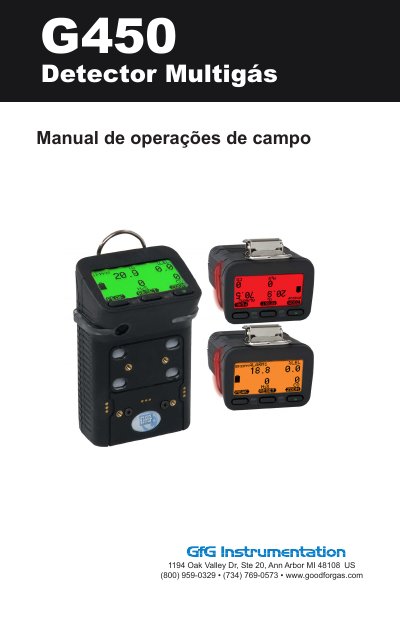
This document serves as a field operations guide for the GfG G450, a portable personal protection device designed to detect gas hazards. It provides essential daily-use information, including safety warnings, operational procedures, and maintenance requirements to ensure the instrument functions correctly in hazardous environments.
The manual details the device's features, such as continuous diffusion mode monitoring and visual/audible alarms. It outlines specific instructions for battery replacement, daily testing, and the two-step calibration process using the Fresh Air AutoCal and gas calibration adapter. Technical specifications for the oxygen, carbon monoxide, hydrogen sulfide, and combustible gas sensors are also provided. This manual is written in Portuguese.
| Oxygen Sensor Response Time (t50) | <10 sec |
|---|---|
| Carbon Monoxide Sensor Response Time (t90) | <45 sec |
| Hydrogen Sulfide Sensor Response Time (t50) | <15 sec |
| Combustible Gas Sensor Response Time (t90) | <30 sec |
| Oxygen Sensor Operating Temperature | -20... +50°C |
| Battery Type | AA Duracell MN1500 LR6 |
| Sensor Life Estimate | 3 years |
Only batteries with model numbers 1450-202, 1450-211, or 1450-212 are permitted for use in the product.
No, batteries must be from the same manufacturer; mixing different models is not allowed.
The calibration adapter should be connected to the instrument to initiate the Fresh Air AutoCal or gas calibration process.
The oxygen, carbon monoxide, hydrogen sulfide, and combustible gas sensors have an estimated useful life of 3 years.