
The GeneCopoeia EndoFectin™-CHO reagent manual provides product overview, storage guidelines, and step‑by‑step transient and stable transfection protocols.
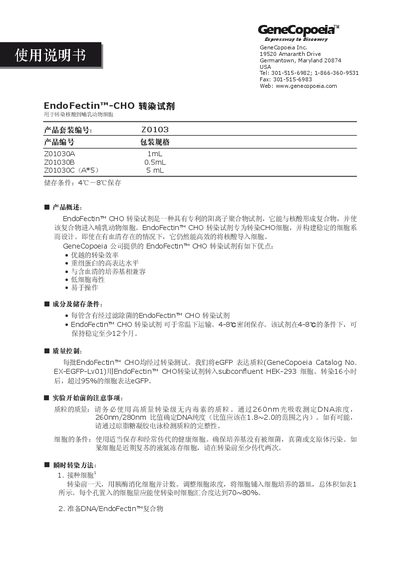
This manual describes the patented cationic polymer EndoFectin™‑CHO, designed for high‑efficiency transfection of CHO cells even in the presence of serum. It outlines the reagent’s advantages, such as superior transfection efficiency, high protein expression, serum‑compatible media, low cytotoxicity, and ease of use.
Detailed procedures cover cell preparation, DNA‑reagent complex formation, transient transfection steps for various culture vessels, and stable transfection workflow including selection of resistant clones. Storage conditions, quality control data, and practical tips for optimizing transfection are also provided. This manual is written in Chinese.
| Storage temperature | 4 °C – 8 °C (sealed) |
|---|---|
| Shelf life at 4‑8 °C | ≥12 months |
| DNA to reagent ratio | 1 µg DNA : 3 µl EndoFectin™ |
| Recommended cell confluence for transfection | 70 % – 80 % |
| Observed transfection efficiency (eGFP) | >95 % of cells |
| Incubation temperature after transfection | 37 °C in CO₂ incubator |
| Earliest detection of gene expression | ≈7 hours post‑transfection |
Store the sealed reagent at 4 °C – 8 °C; it remains stable for at least 12 months under these conditions.
Use 3 µl of EndoFectin™ per 1 µg of DNA (range 1‑4 µl per µg can be optimized).
In quality‑control tests, over 95 % of cells expressed the eGFP reporter after 16 hours.
Gene expression can be detected as early as 7 hours post‑transfection.