
The FST600-207 intrinsic safety temperature sensor from Firsensor measures -200 °C to +100 °C and provides a 4‑20 mA output for hazardous environments.
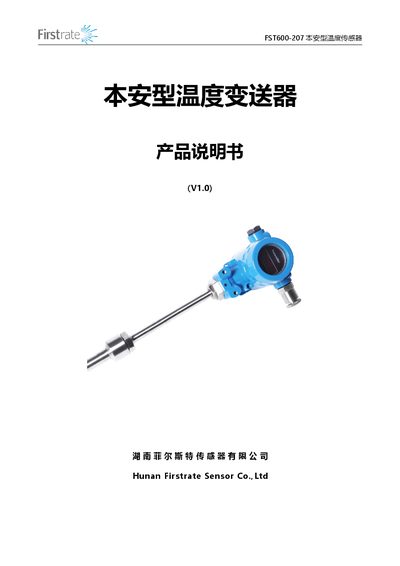
The FST600-207 is an intrinsic‑safety temperature transmitter that combines a thermocouple (or thermistor) with signal‑conditioning circuitry. It outputs a linear 4‑20 mA current proportional to temperature over a range of –200 °C to +100 °C and meets GB3836.1‑2010 and GB3836.4‑2010 explosion‑proof standards (ExiaIICT6Ga) for zones 0, 1 and 2.
Installation must follow GB3836.15‑2010. The unit can be mounted in any orientation and is secured by tightening with a hex wrench. Cable free ends must be prepared and routed into an approved explosion‑proof box, with a minimum cable reserve of 1 m. Safety precautions include avoiding over‑range use, not pulling the cable, and not modifying the device, as any alteration could affect its intrinsic‑safety performance. This manual is written in Chinese.
| Output signal | 4‑20 mA |
|---|---|
| Signal line type | 2‑wire |
| Supply voltage | 24 VDC |
| Intrinsic safety voltage | Ui=28 VDC |
| Linear accuracy | ±0.5 % Span ± 1 % Span |
| Probe pressure (typical) | 40 Bar |
| Probe pressure (max) | 400 Bar |
| Operating temperature range | -40 °C to +60 °C |
| Storage temperature range | -40 °C to +125 °C |
| Ingress protection | IP65 |
| Explosion‑proof rating | ExiaIICT6Ga (zones 0‑2, gases IIA‑IIC, T1‑T6) |
It provides a 4‑20 mA current output.
The sensor can measure temperatures from –200 °C to +100 °C.
It is certified ExiaIICT6Ga for zones 0, 1 and 2, compatible with IIA‑IIC gases and T1‑T6 temperatures.