
The FHWA Distress Identification Manual provides standardized definitions, illustrations, and measurement methods for pavement distress data collection in…
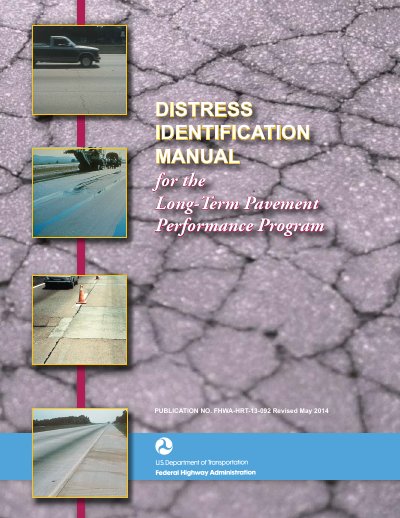
The Distress Identification Manual (DIM) offers a consistent, uniform basis for collecting pavement distress data for the Long‑Term Pavement Performance (LTPP) program. It includes detailed descriptions, photographs, and measurement procedures for a wide range of distress types across three pavement categories: asphalt concrete‑surfaced, jointed Portland cement concrete, and continuously reinforced concrete.
The manual also supplies sample forms for recording data, guidance on fault‑meter measurements, and references to the current LTPP profile manual. It is intended for highway agencies and pavement managers to standardize condition surveys and improve data quality nationwide.
| Publication Number | FHWA-HRT-13-092 |
|---|---|
| Report Date | May 2014 |
| Number of Pages | 142 |
It provides a consistent, uniform basis for collecting pavement distress data for the LTPP program.
The manual is divided into three sections covering asphalt concrete‑surfaced, jointed Portland cement concrete, and continuously reinforced concrete pavements.