
Maintenance manual for the Emhart ProSet 1600 rivet pliers, covering safety, specifications, service procedures and fault troubleshooting.
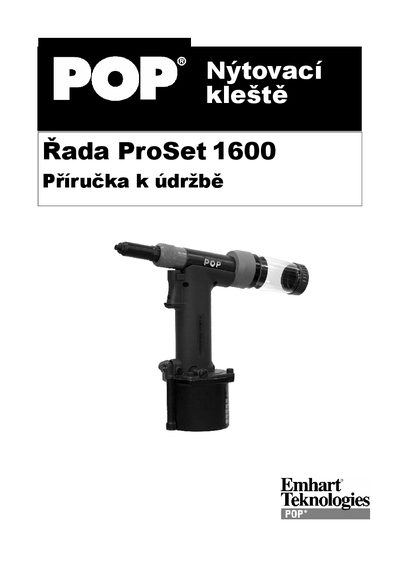
The ProSet 1600 is a lightweight air‑hydraulic rivet plier designed for POP® rivets. This manual provides safety instructions, tool dimensions, required accessories, and detailed service procedures for the front side and the MCS (spike collection system).\n\nIt also includes a parts list, hydraulic oil replacement steps, regular maintenance guidelines, safety data, fault‑finding tables and the EC declaration of conformity. All information is presented in Czech and is intended for qualified service personnel. This manual is written in Czech.
| Weight | 2.14 lb (0.97 kg) |
|---|---|
| Length | 10.83 in (275 mm) |
| Height | 8.94 in (227 mm) |
| Tool Stroke | 0.71 in (18 mm) |
| Pulling Force | 1090 lb at 90 psi (4850 N at 6.2 bar) |
| Air Consumption | 0.043 cu ft/rivet (1.22 L/rivet), max 2.47 scfm (70 L/min) |
The recommended operating pressure is 72.5–90 psi (5.0–6.2 bar) with dry, filtered air.
The head should be tightened to a torque of 6.8–7.3 Nm (60–65 in‑lb).
The tool must not be operated above 6.9 bar.
The damper should be cleaned regularly according to the preventive maintenance schedule, and always disconnect the compressed‑air supply before cleaning.