
A flexible, fast-drying transparent acrylic conformal coating for electronic circuitry protection meeting various international standards.
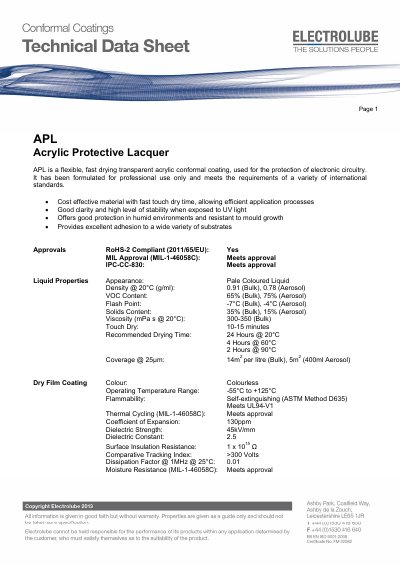
The Electrolube APL is a professional-grade, flexible, and fast-drying transparent acrylic conformal coating designed to protect electronic circuitry. It offers good clarity, high stability under UV light, excellent adhesion to diverse substrates, and resistance to mould growth in humid environments. The product meets several international standards including RoHS-2, MIL-1-46058C, and IPC-CC-830.
The document provides detailed specifications for the liquid properties of APL available in bulk or aerosol formats, along with application instructions for spraying, dipping, and brushing. It also covers packaging options, shelf life, removal solvents, and safety information regarding flammability and thermal cycling.
| Appearance | Pale Coloured Liquid |
|---|---|
| Density @ 20°C (Bulk) | 0.91 g/ml |
| Flash Point (Bulk) | -7°C |
| Solids Content (Bulk) | 35% |
| Viscosity @ 20°C | 300-350 mPa s |
| Touch Dry Time | 10-15 minutes |
| Operating Temperature Range | -55°C to +125°C |
| Dielectric Strength | 45kV/mm |
Yes, it is RoHS-2 Compliant (2011/65/EU).
The recommended drying time is 24 hours at 20°C, 4 hours at 60°C, or 2 hours at 90°C.
APL can be sprayed, dipped, or brushed depending on the required thickness.