
EFCO VALVE-DOC is a documentation and administration system for set-pressure and seat leakage tests of safety relief valves and shut-off valves.
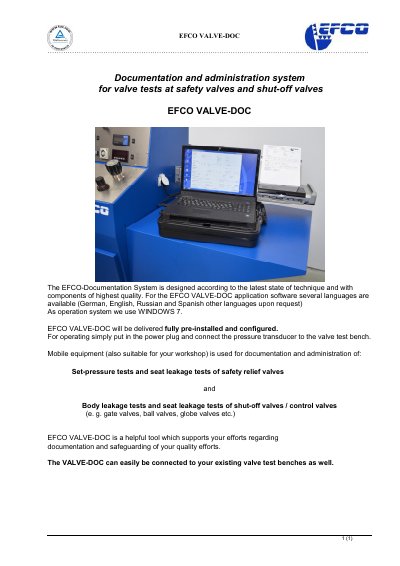
EFCO VALVE-DOC is a documentation and administration system for valve tests, delivered pre-installed and configured on a notebook that uses Windows 7 as operating system. It is used for set-pressure tests and seat leakage tests of safety relief valves, and for body pressure tests and seat leakage tests of shut-off valves and control valves such as gate valves, ball valves and globe valves. The system connects to an existing valve test bench through a pressure transducer.
Test data is entered, analyzed and imported into a database on the hard disk, can be backed up onto a USB stick, and is printed as a valve test report. Tolerance values for set-pressure and body pressure tests are entered in percentage of the desired test pressure, and up to 8 pressure transducers are possible. Valve log cards record all work executed on a specific valve together with the date and can be printed; the screens, test reports and manual instructions are available in German, English, Spanish or Russian, with other languages upon request.
| Operating system | Windows 7 |
|---|---|
| Pressure transducers supplied | 2 pieces, accuracy class 0.5 |
| Pressure ranges | 0 - 60 bar and 0 - 250 bar (others upon request) |
| Supported pressure transducers | up to 8 |
| Software and report languages | German, English, Russian, Spanish (other languages upon request) |
| Scope of supply | Notebook, black box (input/output card), pre-installed software package, 2 pressure transducers, colour notebook printer, accessories, manual instructions, system carrying case |
For safety relief valves it covers set-pressure tests and seat leakage tests, and for shut-off valves and control valves it covers body pressure tests and seat leakage tests.
They are available in German, English, Spanish or Russian; other languages are available upon request.
Yes, the system can easily be connected to existing valve test benches.
The data is imported into a database on the hard disk and can also be backed up onto a USB stick.