
Comparison table and data sheet for ECA's A205P and µPC2500H integrated audio amplifier circuits, detailing technical parameters and performance.
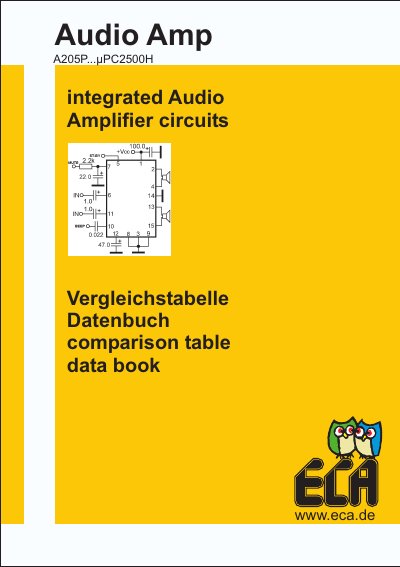
This document provides a comparison table and data sheet for ECA's A205P and µPC2500H integrated audio amplifier circuits. It details technical parameters, performance characteristics, and application schematics for both models. The content is intended for engineers and technicians working with audio amplification systems in consumer electronics and professional applications.
The document covers key amplifier specifications such as gain, bandwidth, distortion metrics (THD, SNR), power output ratings (PMPO, musical power, sinusoidal power), and input/output impedance characteristics. It also explains the operational principles and potential nonlinear distortions in amplifier circuits. This manual is written in German.
| Gain | Ratio of output signal to input signal |
|---|---|
| Bandwidth | Frequency range between lower cutoff frequency f1 and upper cutoff frequency f2 |
| THD | Total Harmonic Distortion, typically < 0.5% |
| SNR | Signal-to-noise ratio in decibels |
| PMPO | Peak Music Power Output, theoretical maximum power without damage |
PMPO (Peak Music Power Output) indicates the theoretical maximum power an amplifier can deliver without damage, though it does not specify how long such output can be sustained.
The gain (Gv) is the ratio of the output signal to the input signal, and it can be expressed as a direct ratio or as a logarithmic ratio in dB.
The output power ratings are valid only when the specified load resistance (load impedance) Rl is used. With a different load impedance, the output power drops, and a too low load resistance can destroy the amplifier.
Music power is the short-time maximum allowable output of an amplifier or end stage, and it can be considerably higher than sine power. Sine power can be driven indefinitely without disturbances or performance losses and is therefore always smaller than music power.