
This manual provides instructions for the installation, startup, calibration, and maintenance of the Det-Tronics Model 505 Combustible Gas Detector Transmitter.
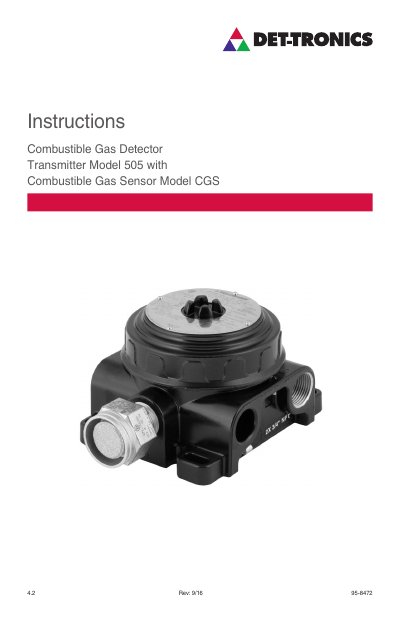
The Det-Tronics Model 505 Transmitter is designed to work with a constant voltage catalytic gas sensor (Model CGS) to provide a linear 4 to 20 mA output signal corresponding to a 0 to 100% Lower Flammable Limit (LFL) gas concentration. The device includes an explosion-proof junction box with options for different materials, conduit entry ports, and signal output load impedances.
| Output Signal | 4 to 20 mA |
|---|---|
| Measurement Range | 0 to 100% LFL |
| Sensor Type | Constant voltage catalytic bead |
| Low Alarm Setpoint | 20% LFL |
| High Alarm Setpoint | 40% LFL |
| Minimum Oxygen Level | 10% |
The device measures gas concentrations from 0 to 100% Lower Flammable Limit (LFL).
No, catalytic gas sensors require oxygen to measure accurately and should not be used where oxygen is less than 10% by volume.
Substances like dirt, oil, corrosive liquids (e.g., H2S, Cl2), and halogens can clog the flame arrestor or damage the sensor.