
This manual covers setup, tube installation, operation, and specifications for the DECWARE SE84C+ single-ended Class A stereo amplifier.
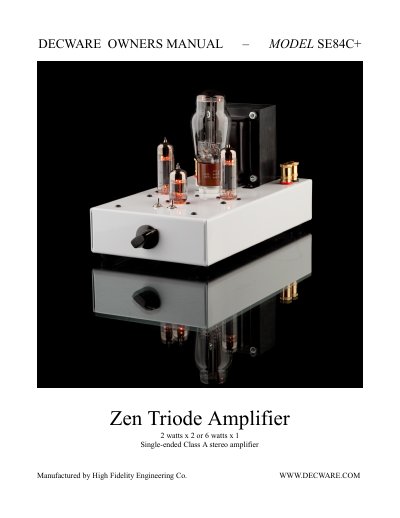
The DECWARE SE84C+ is a single-ended Class A stereo amplifier available in 2 watts x 2 or 6 watts x 1 mono configurations. It features a self-balancing common cathode bias circuit that allows for the use of unmatched output tubes, such as EL84/6BQ5 or SV83/6P15P-EV, while maintaining perfect image focus. The amplifier utilizes a small dual triode input tube (6N1P, 6922, or 6DJ8) and a user-selectable rectifier tube (5U4, 5AR4, or 5Y3GT) to shape the sound signature.
| Power Output | 2 watts x 2 or 6 watts x 1 |
|---|---|
| Class | Class A |
| Output Tube Options | EL84/6BQ5 or SV83/6P15P-EV |
| Input Tube Options | 6N1P or 6922 or 6DJ8 |
| Speaker Impedance Range | 2 to 8 ohms |
| Bias Current | approx 45 mils |
The official warm up time is 60 seconds before you should panic if distortion is heard.
Look through the small square holes in the gray plates inside the output tube to see if the blue glow starts to flicker with the bass line.
Yes, the switch can be operated while listening without damage to the amplifier or speakers, though you will hear a significant pop.
The fastest way is to run the amp for 5 hours with music and 5 hours off, repeating this process 5 times.