
Operation manual for Decagon's SRS spectral reflectance sensor covering setup, connection, data output and troubleshooting.
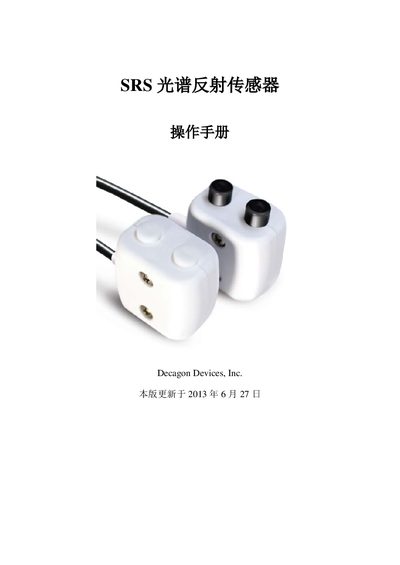
The SRS (Spectral Reflectance Sensor) is a dual‑band sensor that measures NDVI and PRI for vegetation monitoring. It is offered in four models—NDVI hemispherical, NDVI field‑of‑view, PRI hemispherical and PRI field‑of‑view—each with a Teflon diffuser or a 20° aperture.
The manual describes technical specifications, installation procedures, wiring options (3.5 mm ear‑phone plug or custom cable), SDI‑12 communication, compatible data loggers (Decagon EM50 series and Campbell), and troubleshooting steps. This manual is written in Chinese.
| Accuracy | >10% optical irradiance |
|---|---|
| Measurement Time | <300 ms |
| NDVI Band Central Wavelength | 630 nm and 80 nm |
| NDVI Band FWHM | 50 nm and 40 nm |
| PRI Band Central Wavelength | 531 nm and 571 nm |
| PRI Band FWHM | 10 nm |
| Dimensions | 43 mm × 40 mm × 27 mm |
| Power Supply | 3.6 V–15 V DC, 4 mA (read), 30 µA (standby) |
| Operating Temperature | -40 °C to 50 °C |
| Interface Type | 3.5 mm ear‑phone plug or tin‑plated bare wire |
| Cable Length | Standard 5 m, custom lengths available |
The SRS sensor communicates using the SDI‑12 protocol.
It works directly with Decagon EM50, EM50R and EM50G loggers and can also be used with other SDI‑12 loggers such as Campbell models.
Insert the 3.5 mm ear‑phone plug into any of the five ports on the Decagon data logger and configure the port for the SRS sensor in the software.
The sensor requires a DC supply between 3.6 V and 15 V.