
Dallas DS1267 data sheet covers a dual 256-position digital potentiometer with a 3-wire serial interface and 10 kΩ, 50 kΩ, and 100 kΩ versions.
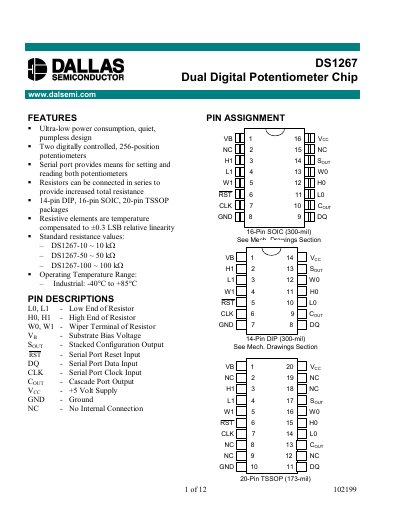
The Dallas DS1267 is a dual digital potentiometer chip with two digitally controlled, solid-state potentiometers. Each potentiometer has 256 resistive sections, and an 8-bit value sets which tap point is connected to the wiper output. Communication and control use a 3-wire serial port interface that allows wiper positions to be read or written.
The DS1267 can stack its two potentiometers in series for increased total resistance and 512 steps, or multiple devices can be daisy-chained for control over a single 3-wire bus. Standard resistance values are 10 kΩ, 50 kΩ, and 100 kΩ, with 14-pin DIP, 16-pin SOIC, and 20-pin TSSOP packages.
| Potentiometers | Two digitally controlled, 256-position potentiometers |
|---|---|
| Serial interface | 3-wire serial port interface |
| Standard resistance values | 10 kΩ, 50 kΩ, 100 kΩ |
| Packages | 14-pin DIP, 16-pin SOIC, 20-pin TSSOP |
| Operating temperature range | -40°C to +85°C |
| Supply voltage | 5.0 V ±10% |
| Wiper resistance | 400–1000 Ω |
| Power-up wiper position | 50% of total resistance |
| Stacked resolution | 512 steps (9 bits) |
| Relative linearity | ±0.3 MI typical |
It contains two digitally controlled, solid-state potentiometers.
The three input signals are RST, CLK, and DQ.
At power-up, the wiper positions are set at 50% of the total resistance, or binary value 1000 0000.
Yes. Multiple DS1267s can be linked or daisy-chained for control from a single processor.