
The ANT 8811 is a 3.5 W, 3.7 V mono audio amplifier with ultra‑low EMI, low noise, AB/D mode and built‑in protection.
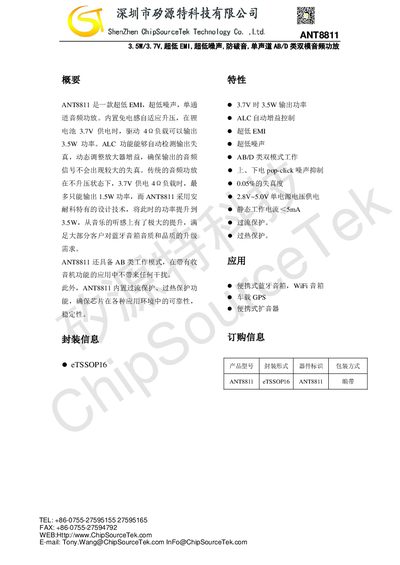
The ANT 8811 audio power amplifier delivers up to 3.5 W into a 4 Ω load when powered from a 3.7 V battery. It features an adaptive boost circuit, automatic gain control (ALC), and can operate in either AB or Class‑D mode.
The device is supplied in an eTSSOP‑16 package and includes over‑current and over‑temperature protection, low static current (<5 mA), and a wide supply range of 2.8‑5.0 V. Typical applications are portable Bluetooth speakers, Wi‑Fi speakers, car‑mounted GPS units, and handheld amplifiers. This manual is written in Chinese.
| Output Power | 3.5 W into 4 Ω |
|---|---|
| Supply Voltage Range | 2.8 V – 5.0 V |
| Signal‑to‑Noise Ratio | 90 dB |
| Efficiency | ≈ 80 % at 3.5 W |
| Over‑Current Protection | 3 A |
| Over‑Temperature Protection | 150 °C |
It can deliver up to 3.5 W into a 4 Ω load when powered from a 3.7 V battery.
The device includes over‑current and over‑temperature protection circuits.
The recommended operating supply voltage is from 2.8 V to 5.0 V.
Gain is set by the external resistor ratio according to Av = Rf / Ri, where Rf = 320 kΩ.