
User guide for RAMSES 3.0, a self-gravitating fluid dynamics simulation code with adaptive mesh refinement for massively parallel computers.
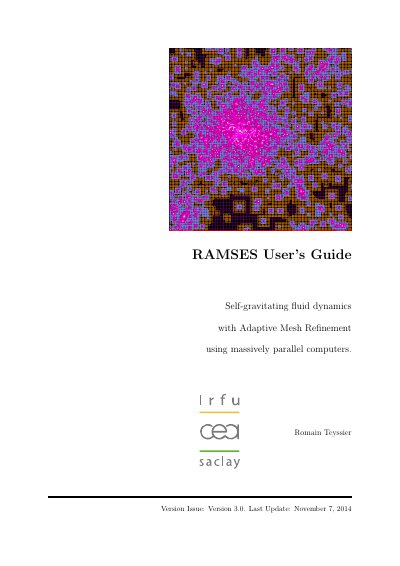
The RAMSES package provides a versatile platform for computational astrophysics using adaptive mesh refinement (AMR) to solve the Euler equations with self-gravity and cooling. It supports Cartesian AMR grids in 1D, 2D, or 3D, multiple Riemann solvers, collision-less particle dynamics, and models for star formation and supernova feedback. The code runs on massively parallel architectures via MPI or on single processors, and includes post-processing utilities for output analysis.
This guide covers obtaining the code from the Bitbucket repository, compiling with configurable Fortran compiler flags and preprocessor directives (dimensionality, solver type, MPI, precision), and executing test cases such as the Sod shock tube. It details runtime parameters via Fortran namelist files, cosmological simulation setup, memory management, restarting runs, parallel computing, and advanced topics like patching the code, physical units, and external gravity or thermal sources.
| Supported dimensions | 1D, 2D, 3D |
|---|---|
| MPI support | Optional, enabled by default |
| Precision options | Single (NPRE=4) or double (NPRE=8) |
| AMR grid | Cartesian with adaptive refinement |
| Poisson solver | Multi-grid and Conjugate Gradient |
| Riemann solvers | Lax-Friedrich, HLLC, exact |
| Particle dynamics | Collision-less (dark matter, stars) via PM code |
RAMSES can be downloaded from the Bitbucket repository at https://bitbucket.org/rteyssie/ramses using git clone.
Execute the compiled binary with a namelist parameter file, e.g., bin/ramses1d namelist/tube1d.nml.