
The Bynatec M16 development board user manual provides safety guidelines, hardware specifications, and connection details for the ATMEGA16‑based board.
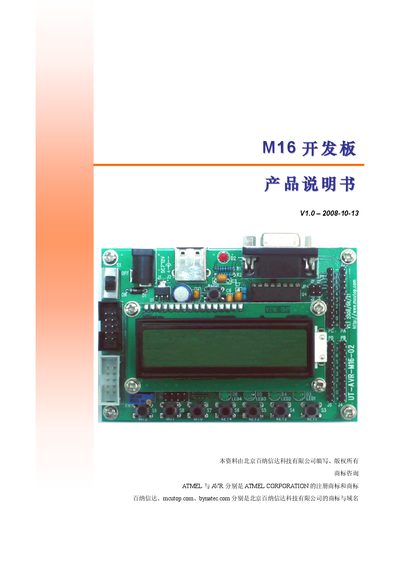
This manual describes the M16 development board, which is built around an Atmel ATMEGA16 microcontroller and uses a modular layout suitable for students and engineers. It includes a complete list of hardware resources, safety notices, and wiring diagrams.
The document covers the board’s dimensions, power options (DC or USB), connector pinouts (JTAG, ISP, serial, LCD), and the functions of each peripheral such as LEDs, buttons, buzzer, analog input, and LCD display. This manual is written in Chinese.
| Board size (without LCD) | 106 × 72.5 × 14 mm |
|---|---|
| Board size (with LCD) | 106 × 72.5 × 22 mm |
| Operating voltage | DC 7 ~ 15 V |
| Microcontroller | ATMEGA16 |
| LEDs | 4 |
| Buttons (including reset and interrupt) | 8 |
| Analog input channels | 1 |
| LCD module | 1 × 8‑segment display |
The board operates from DC 7 V to 15 V.
The board includes four standard LEDs plus a power‑indicator LED.
It can be powered either by a DC regulated supply or via the USB connector.
It uses an Atmel ATMEGA16 microcontroller.