
This manual explains the features, wiring, specifications and operation of the BWGP MGP wireless handwheel for CNC machines.
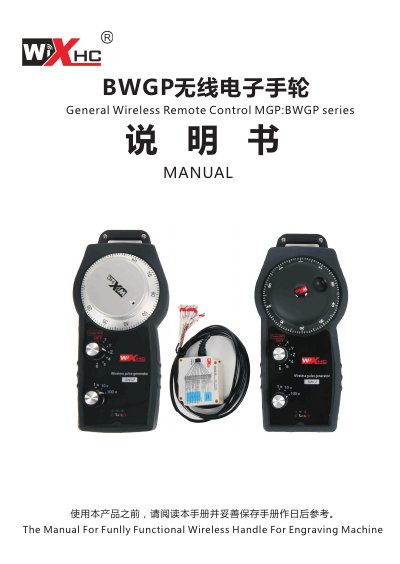
The BWGP MGP wireless handwheel provides a 433 MHz ISM‑band remote control for CNC systems such as Siemens, Mitsubishi, FANUC and many others. It offers up to 32 handwheels in the same room without interference, low‑power operation with two AA batteries lasting about 30 days, and an alloy encoder for reliable positioning.
The manual includes installation steps, receiver wiring diagrams, model naming rules, and a pulse‑output selection guide covering various CNC platforms. Detailed dimensions (184 mm × 80 mm × 31 mm) and electrical parameters are also provided. This manual is written in Chinese.
| Wireless frequency | 433 MHz ISM band |
|---|---|
| Transmit power | 10 dB |
| Receive sensitivity | -98 dB |
| Maximum unobstructed range | 50 m |
| Battery type and life | 2 AA batteries, ~30 days |
| Dimensions (handwheel) | 184 mm × 80 mm × 31 mm |
| Encoder type | Alloy encoder |
| Maximum units per room | 32 sets |
It operates on the 433 MHz ISM band.
Two AA batteries provide about 30 days of normal use.
Up to 32 wireless handwheels can operate in one room without affecting each other.
A fast flashing light means the wireless signal is normal; a slow irregular flash means the signal is abnormal; no light means the signal is lost.