
Product manual for HDPE/PP woven sacks used to package 50 kg food grains, per Indian Standard IS 14887:2014.
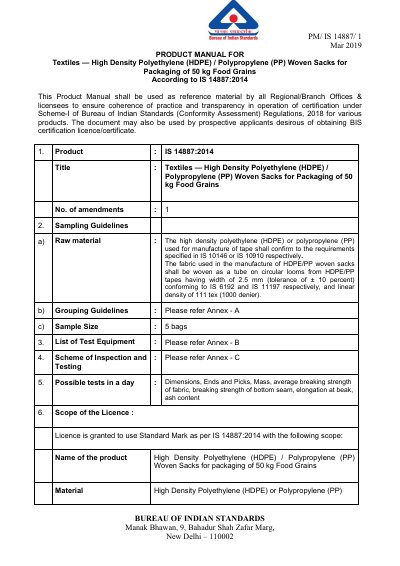
This document outlines the standards, testing procedures, and inspection schemes for HDPE and PP woven sacks used to package 50 kg food grains. It includes sampling guidelines, required test equipment, and levels of control for manufacturers seeking BIS certification. The manual also specifies marking requirements and disposal protocols for non-conforming products.
The document is intended for use by BIS licensees and regional offices to ensure consistent quality control and conformity assessment under Scheme-I of the BIS Conformity Assessment Regulations, 2018.
| Material | High Density Polyethylene (HDPE) or Polypropylene (PP) |
|---|---|
| Fabric Linear Density | 111 tex (1000 denier) |
| Tape Width | 2.5 mm (tolerance of ± 10 percent) |
| Test Equipment for Tapes | Steel Rule / Vernier 0.1mm LC, Spring Loaded dial micrometer of 0.001mm LC & 140kN/m2 pressure |
| Ash Content Testing | Weighing Balance 1mg accuracy, Silica crucible, Bunsen Burner, Muffle furnace |
The standard is IS 14887:2014, as specified in the document.
Five bags are sampled for testing, as per the sampling guidelines.
The standard mark, BIS Licence Number, and website URL must be marked on each sack.
Rejected material must be defaced, sheared, or cut for re-melting, and stored separately from conforming material.